
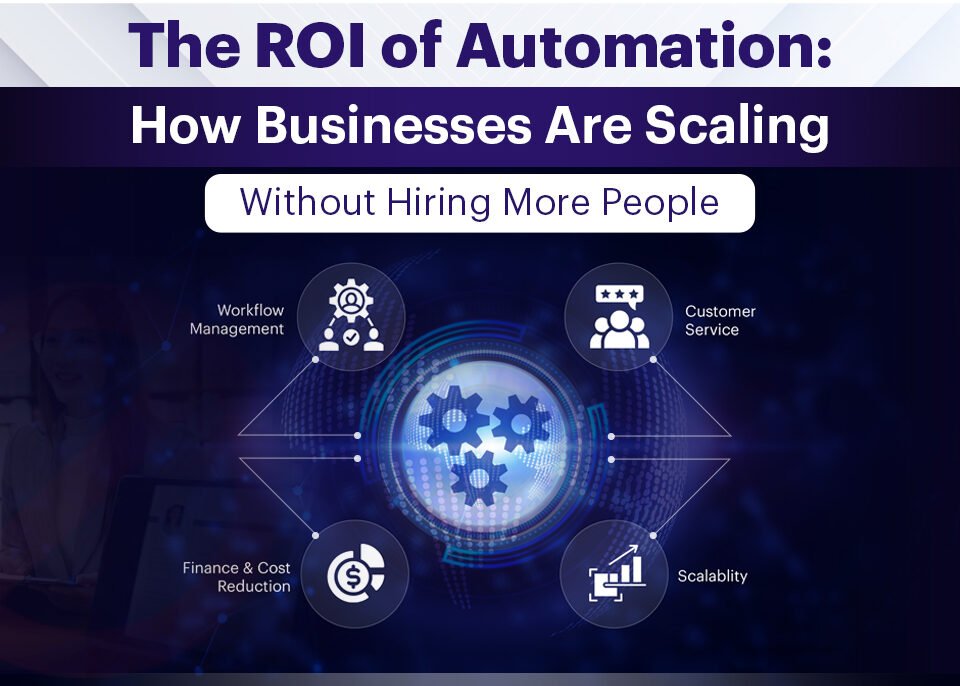

Across nearly every industry, one pattern has become increasingly clear: Businesses are scaling faster than ever—without increasing headcount.
Instead of relying on larger teams, companies are investing in smarter systems. Automation has evolved from a “nice-to-have” efficiency tool into a core growth strategy, enabling organizations to streamline workflows, reduce manual effort, and achieve more with the same number of people. But the most important question leaders ask is simple:
What is the real ROI of automation—and why are so many businesses choosing it over hiring?
This article breaks down the financial, operational, and strategic returns automation delivers—and why it has become one of the highest-ROI investments modern businesses can make.
1. Reducing Operational Costs Without Sacrificing Output
Hiring employees comes with long-term financial commitments: salaries, onboarding, benefits, training, and ongoing overhead. Automation removes many of these recurring costs by handling work that previously required manual labor.
A key benefit is improved operational efficiency, which research shows is a primary driver of sustainable cost reduction.
Automation helps teams:
- Complete tasks faster
- Reduce human error
- Operate consistently 24/7
- Eliminate task switching
- Remove repetitive manual processes
Instead of scaling payroll, businesses scale output.
Example:
A company that once required three employees to handle lead entry, follow-ups, and reporting can automate all three—reducing labor costs for that function by up to 60–70%. Small automations compound into major savings over time.
2. Faster Execution Improves Business Scalability
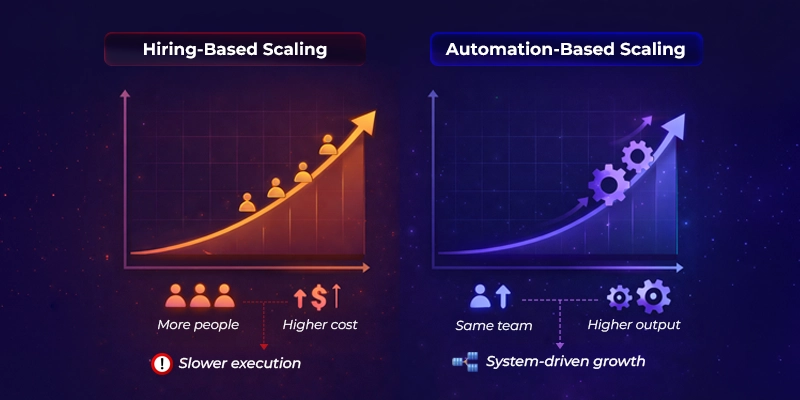
Traditionally, growth meant hiring more people. Today, businesses scale through systems. Automation accelerates scalability by enabling process automation, which reduces cycle times and increases throughput.
With automation, businesses can:
- Process more leads
- Manage more customers
- Produce more content
- Fulfill more orders
- Run more campaigns
—all without increasing team size.
This is why automation is often described as a scaling multiplier rather than a cost-saving tool.
3. Better Customer Experiences With Less Manual Work
Modern customers expect fast, consistent, and personalized experiences. Automation delivers all three—without increasing workload. By leveraging tools like customer journey mapping, businesses can design automated paths that adapt to customer behavior and intent.
Automation enables:
- Instant responses to inquiries
- Seamless onboarding flows
- Personalized recommendations
- Perfectly timed follow-ups
- 24/7 customer support
These experiences once required large support teams. Today, automation executes them reliably at scale.
ROI impact includes:
- Higher customer retention
- Increased lifetime value (LTV)
- More repeat purchases
- Improved customer satisfaction
4. Eliminating Human Error Improves Consistency
Manual processes inevitably introduce errors: missed follow-ups, incorrect data entry, inconsistent messaging, and forgotten tasks. Automation eliminates these risks by executing workflows the same way every time. Studies on workflow standardization show that automation dramatically improves consistency by removing human variability.
Why this matters for ROI:
- Fewer errors = less rework
- Consistent quality = stronger trust
- Reliable processes = repeatable revenue
Automation delivers dependable outcomes without constant supervision.
5. Increasing Employee Productivity Without Burnout
Automation doesn’t replace employees—it empowers them. When teams aren’t stuck doing repetitive tasks, they can focus on strategic, creative, and revenue-driving work. Research on workforce productivity shows that automation allows employees to contribute more value without increasing stress.
Automation improves productivity by:
- Reducing task-switching fatigue
- Eliminating manual admin work
- Allowing larger workloads to be managed efficiently
- Providing real-time system insights
ROI insight:
One employee supported by automation can often perform the work of three—not through overwork, but through better systems.
6. Enabling Data-Driven Decision Making
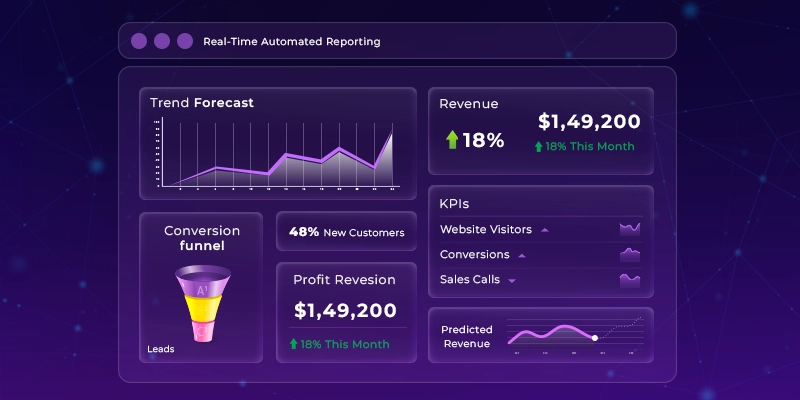
One of automation’s most underestimated benefits is data collection.
Automated systems track:
- Performance metrics
- Customer behavior
- Conversions and revenue
- Funnel drop-offs
This data fuels predictive analytics, which improve forecasting accuracy and decision-making.
Benefits include:
- Faster reporting cycles
- More accurate forecasts
- Better budget allocation
- Real-time operational adjustments
Automation doesn’t just save money—it amplifies intelligence.
7. Automation Delivers Compounding Long-Term Returns
Unlike employees, automation doesn’t scale costs linearly.
Each automated workflow:
- Runs thousands of times
- Saves hours every week
- Reduces errors continuously
- Improves consistency
- Increases operational capacity
This compounding effect is why automation often delivers ROI far beyond traditional investments.
Returns appear in:
- Labor cost reduction
- Faster delivery timelines
- Higher customer retention
- Increased conversion rates
- Lower overhead
- Stronger team productivity
8. Scaling Without Hiring Creates Competitive Advantage
Businesses that scale through automation gain clear advantages:
- Lower operating costs
- Faster time-to-market
- Higher output per employee
- More resilient workflows
- Reduced operational complexity
In competitive markets, automation becomes one of the few sustainable ways to grow without burning resources or burning out teams.
Final Thoughts
Automation has evolved into a growth engine, not just a productivity tool.
It delivers measurable ROI through:
- Cost reduction
- Higher output
- Better customer experiences
- Improved decision-making
Most importantly, automation enables businesses to scale without hiring more people—creating leaner operations, stronger margins, and long-term competitive advantage. The businesses that invest in automation today will become the category leaders of tomorrow.