

1. Overview
In lead-generation businesses, a large percentage of leads never convert—not because they are unqualified, but because they disengage over time. Without a structured follow-up system, these leads remain inactive, creating lost revenue opportunities.
To solve this, I implemented an Automated Lead Revival System using Email + SMS. The system identifies cold leads based on inactivity, routes them into a multi-step reactivation sequence, and re-engages them through reminders, value reinforcement, and timed offers.
Instead of treating cold leads as lost, the system converts them into a recoverable pipeline segment, operating continuously without manual intervention.
2. Background & Context
The system was designed for lead-generation environments such as:
◉ Service-based businesses
◉ Consultation funnels
◉ High-ticket offer pipelines
◉ Agencies managing multiple lead sources
Typical lead flow included:
◉ Form submissions (website / landing pages)
◉ Paid traffic (Meta / Google Ads)
◉ CRM-stored contacts
◉ Leads with no follow-up after initial interaction
Before automation, these leads:
◉ Received minimal or inconsistent follow-ups
◉ Dropped off after initial contact
◉ Were rarely revisited systematically
◉ Were dependent on manual outreach efforts
The objective was to create a structured reactivation layer within the CRM lifecycle.
3. Problem Statement
The system needed to solve:
◉ 1. Leads becoming inactive after initial capture
◉ 2. No defined “cold lead” classification logic
◉ 3. Manual follow-ups being inconsistent or skipped
◉ 4. No structured re-engagement workflow
◉ 5. Lost opportunities from previously interested users
Cold leads were accumulating, but no system existed to recover them.
4. Tools & Automation Stack
◉ CRM platform (HubSpot / GoHighLevel / similar)
◉ Email automation system
◉ SMS automation integration
◉ Behavioral tracking (lead activity, last engagement timestamp)
◉ Tagging & segmentation logic
◉ Conditional workflow builder
This allowed the system to operate across multiple communication channels.
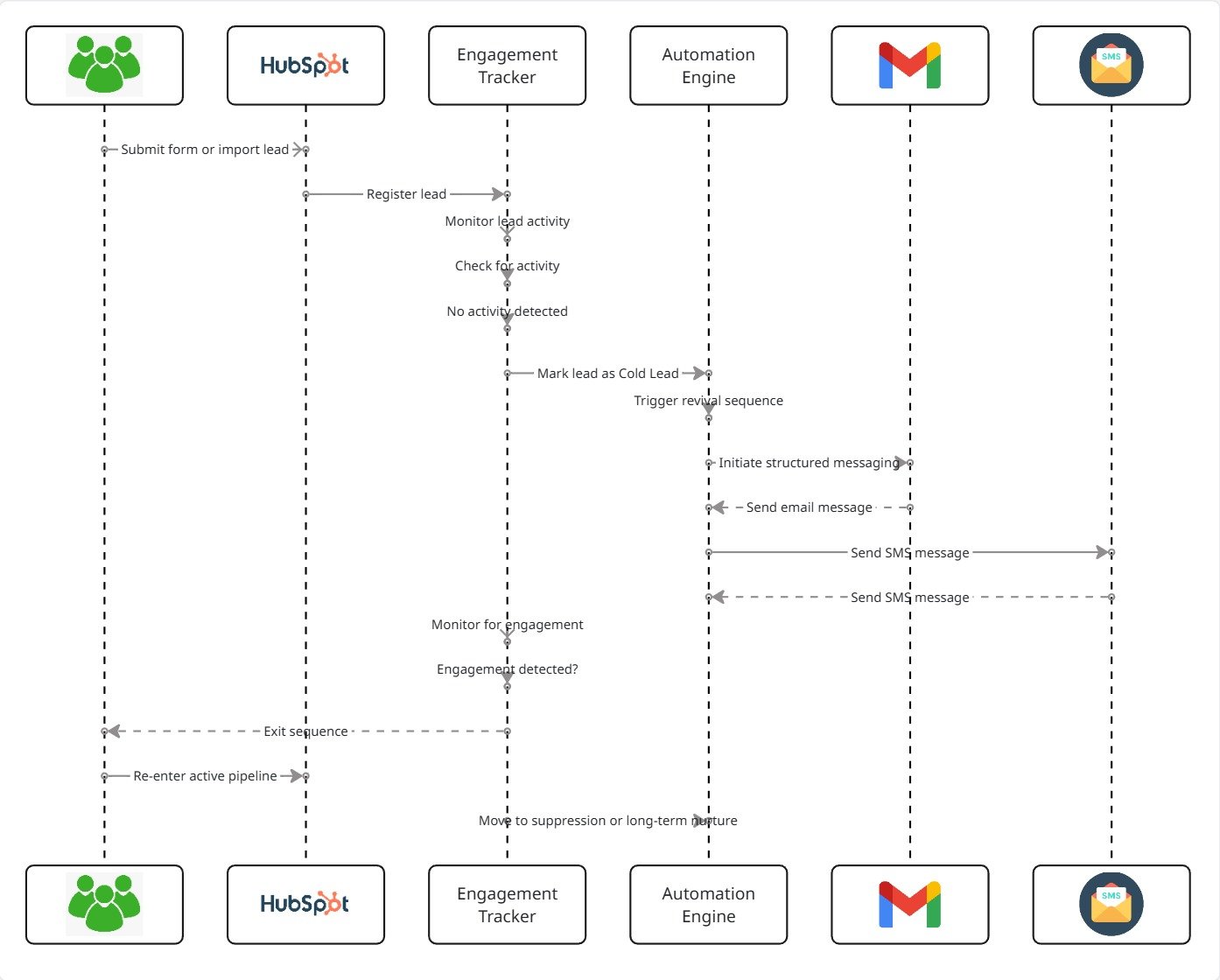
5. Automation Flow
The system followed this lifecycle:
◉ 1. Lead enters CRM (form submission / import)
◉ 2. Lead engagement is tracked over time
◉ 3. If no activity within defined window → marked as “Cold Lead”
◉ 4. Lead enters revival sequence (Email + SMS)
◉ 5. Sequence delivers structured messaging over multiple steps
◉ 6. If engagement detected → lead exits sequence and re-enters active pipeline
◉ 7. If no engagement → lead moves to suppression or long-term nurture
This created a continuous reactivation loop.
6. Implementation Details
6.1 Cold Lead Identification Logic
A lead was classified as “cold” based on:
◉ No email opens within defined period
◉ No link clicks
◉ No replies or conversions
◉ No CRM activity (calls, notes, updates)
Example logic:
◉ Lead inactive for X days → Tag: Cold Lead
◉ Lead inactive for extended period → Tag: Deep Cold
This segmentation triggered the revival system.
6.2 Revival Sequence Structure (Email + SMS)
The sequence was designed in stages:
Stage 1 — Reminder Layer
◉ “You showed interest earlier” messaging
◉ Soft re-engagement tone
Stage 2 — Value Reinforcement
◉ Benefits reminder
◉ Social proof or use-case context
Stage 3 — Offer / Incentive
◉ Discount / consultation / limited-time offer
Stage 4 — Urgency Layer
◉ Time-bound reminder
◉ Scarcity messaging
Stage 5 — Final Attempt
◉ Last call before suppression
SMS was used strategically:
◉ For high-priority reminders
◉ For urgency reinforcement
◉ For leads not opening emails
6.3 Channel Coordination Logic
The system ensured:
◉ SMS not sent if lead recently engaged via email
◉ Email suppressed if SMS triggered response
◉ Timing gaps maintained between channels
◉ No duplicate messaging across channels
This prevented communication overload.
6.4 AI Prompt (Optional Message Personalization Layer)
For dynamic message generation:
You are a conversion-focused CRM strategist.
Given:
◉ Lead inactivity duration
◉ Lead source
◉ Previous interaction context
Generate:
◉ 1) A short re-engagement message
◉ 2) A benefit-focused reminder
◉ 3) A clear CTA
Tone: direct, helpful, non-pushy.
Avoid generic messaging.
This allowed scalable personalization.
6.5 Exit Conditions
A lead exited the revival sequence if:
◉ Email opened or clicked
◉ SMS replied
◉ Conversion event triggered
◉ Manual CRM activity detected
This ensured leads were not over-contacted.
7. Score Mapping / Classification Logic
| Status | Meaning | Action |
|---|---|---|
| Active | Recently engaged | Normal pipeline |
| Cooling | Engagement declining | Monitor |
| Cold | No engagement within threshold | Enter revival flow |
| Revived | Re-engaged during sequence | Return to pipeline |
| Dead | No response after full sequence | Suppress or archive |
This created clear lifecycle segmentation.
8. CRM Automations
The system included:
◉ Auto-tagging for inactivity
◉ Workflow triggers for revival sequence
◉ Task creation for high-value leads
◉ Reassignment to sales if re-engaged
◉ Suppression rules for non-responsive leads
This connected automation with human follow-up when needed.
9. Code-to-Business Breakdown
| System Component | Business Impact |
|---|---|
| Cold lead tagging | Identifies recoverable opportunities |
| Multi-step revival sequence | Re-engages inactive leads |
| Email + SMS coordination | Improves response probability |
| Exit logic | Prevents over-communication |
| CRM task creation | Converts engagement into action |
| Suppression system | Maintains lead database quality |
10. Real-World Brand Scenario: Deployment Inside Care Plus Advantages
About Care Plus Advantages (Operating Environment)
Care Plus Advantages operates as a healthcare-focused lead generation and enrollment organization, where inbound leads are a primary driver of consultations and conversions. Leads enter the system through multiple channels, including paid media, landing pages, and inbound inquiries, and require structured follow-up to move toward enrollment.
Given the nature of healthcare decision-making, lead conversion often depends on timely follow-up, trust-building communication, and repeated engagement, rather than immediate action after initial contact.
How Lead Follow-Up Worked Before the System
Before the automated revival system was introduced:
◉ Leads were stored in the CRM after initial capture
◉ Follow-ups depended heavily on manual outreach
◉ Inactive leads were rarely revisited systematically
◉ Engagement dropped significantly after the first interaction
◉ No structured reactivation process existed
As a result, a large portion of leads became inactive without being fully utilized.
Why the Need Became Critical
As Care Plus Advantages increased lead acquisition volume:
◉ A growing number of leads became inactive over time
◉ Manual follow-up could not scale with lead volume
◉ Previously interested leads were left unengaged
◉ Conversion potential decreased due to delayed re-engagement
◉ The CRM functioned more as storage than an active pipeline
At this stage, recovering inactive leads became essential to improving overall funnel efficiency.
How the System Was Implemented in Practice
The automated lead revival system was introduced as a reactivation layer within the CRM lifecycle.
Key implementation principles included:
◉ Defining clear inactivity thresholds for cold lead classification
◉ Automatically tagging leads based on engagement behavior
◉ Triggering multi-step Email + SMS revival sequences
◉ Coordinating communication across channels to avoid overlap
◉ Routing re-engaged leads back into the active pipeline
◉ Suppressing unresponsive leads after sequence completion
The system operated continuously, ensuring no lead remained inactive without structured follow-up.
How Execution Changed After Adoption
Once deployed inside Care Plus Advantages:
◉ Cold leads were automatically identified and re-engaged
◉ Follow-up became consistent and system-driven
◉ Previously inactive leads re-entered the pipeline
◉ Manual outreach dependency was significantly reduced
◉ CRM transitioned from passive storage to an active conversion system
Lead management shifted from reactive handling to continuous lifecycle engagement.
11. Results & Structural Impact
Reactivation Layer Added
◉ Cold leads became part of an active system
◉ No lead remained untouched indefinitely
Reduced Lead Wastage
◉ Previously inactive leads were re-engaged
◉ Improved utilization of existing lead database
Improved Lifecycle Coverage
◉ Funnel extended beyond initial lead capture
◉ Engagement tracked across the full lifecycle
Scalable Follow-Up System
◉ System operated without manual intervention
◉ Consistent re-engagement across all leads
12. Challenges & Adjustments
During live usage:
Defining cold lead thresholds accurately
◉ Standardized inactivity windows across CRM
Risk of over-communication
◉ Implemented channel coordination logic and exit triggers
Low response from deeply inactive leads
◉ Introduced tiered messaging with value and incentive layers
CRM clutter from long-term inactive leads
◉ Added suppression and archive rules
13. Key Learnings
◉ Cold leads are not lost — they require structured re-engagement
◉ Lifecycle automation must include revival stages
◉ Multi-channel communication increases recovery probability
◉ Exit logic is critical to maintain engagement quality
◉ CRM systems should function as active pipelines, not static databases
14. Conclusion
This case study demonstrates how an Automated Lead Revival System using Email + SMS can be implemented inside a healthcare lead generation environment like Care Plus Advantages.
By introducing a structured reactivation layer, the system transformed inactive leads into a recoverable asset, reduced lead wastage, and ensured continuous engagement across the entire lifecycle—turning the CRM into a scalable, system-driven conversion engine without increasing operational workload.
Trying to Re-Engage Cold Leads Automatically Using Email + SMS?