

1. Overview
In e-commerce, sending the same message to every customer leads to declining engagement and poor retention. Customers behave differently based on how recently they purchased, how often they engage, and how much they spend.
To address this, I built an Automated Customer Segmentation System using Shopify + Klaviyo that classifies customers using RFM logic (Recency, Frequency, Monetary value).
The system dynamically updates customer segments in real time, allowing campaigns and flows to target users based on actual behavior—ensuring relevance, improving retention, and increasing engagement quality.
2. Background & Context
The system was designed for e-commerce environments with:
◉ High customer volume
◉ Repeat purchase potential
◉ Email/SMS lifecycle marketing (Klaviyo)
◉ Shopify as the primary transaction source
Before segmentation automation, the brand faced:
◉ Generic campaigns sent to entire lists
◉ Limited behavioral targeting
◉ Weak differentiation between customer types
◉ Missed opportunities for retention and upsell
Customer data existed—but it was not structured for action.
3. Problem Statement
The system needed to solve:
◉ 1. Lack of behavioral segmentation across customers
◉ 2. No clear classification of customer value tiers
◉ 3. Static segments that became outdated quickly
◉ 4. Inability to personalize campaigns effectively
◉ 5. Over-reliance on broad messaging
The goal was to create a real-time, behavior-driven segmentation system.
4. Tools & Automation Stack
◉ Shopify (order and customer data source)
◉ Klaviyo (segmentation and automation engine)
◉ RFM scoring logic (Recency, Frequency, Monetary)
◉ Automation workflows (Klaviyo flows / external orchestration)
◉ Tagging and property enrichment system
◉ Optional: Google Sheets / database for scoring logs
This enabled dynamic customer classification.
5. Automation Flow
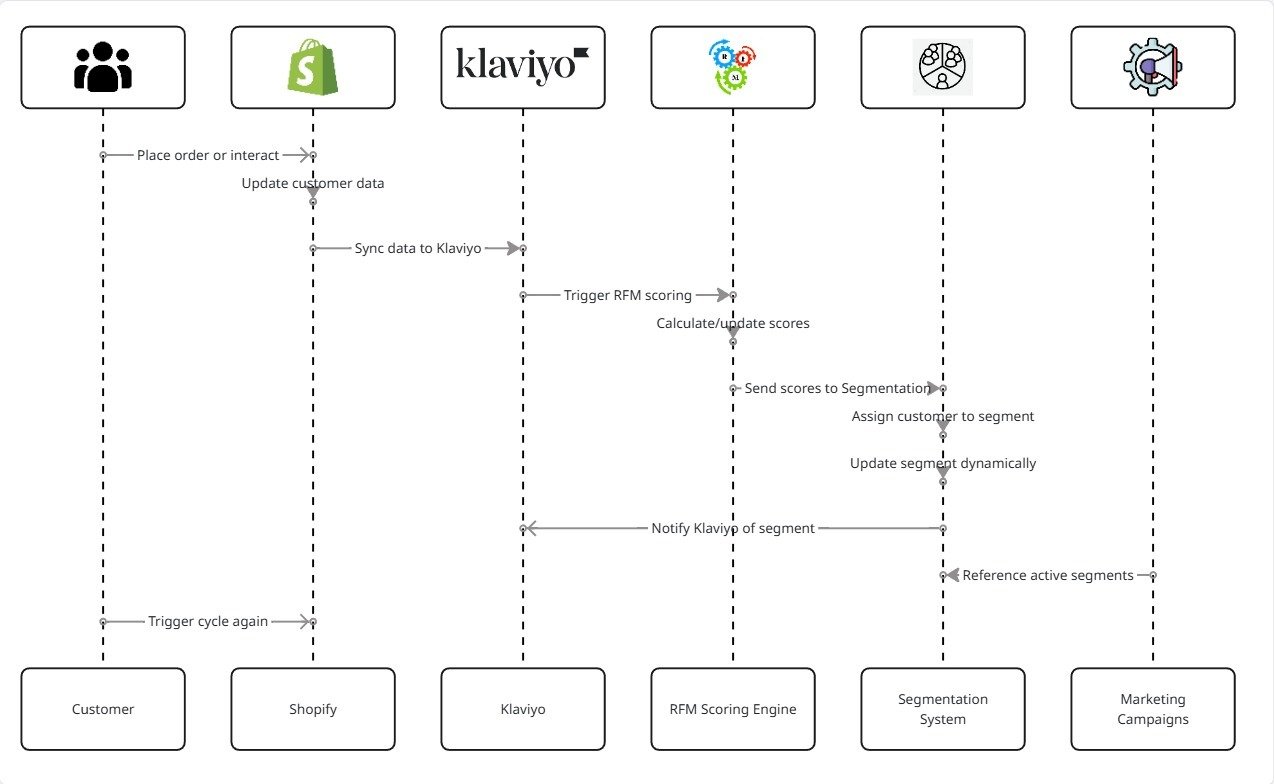
The segmentation system followed this structure:
◉ 1. Customer places order or interacts with brand
◉ 2. Shopify updates customer data (orders, value, timestamps)
◉ 3. Data is synced to Klaviyo
◉ 4. RFM scores are calculated or updated
◉ 5. Customer assigned to segment based on score
◉ 6. Segments updated dynamically in real time
◉ 7. Campaigns and flows reference these segments
◉ 8. Customer moves between segments as behavior changes
This created a continuously evolving segmentation model.
6. Implementation Details
6.1 RFM Scoring Model
Each customer was evaluated based on:
◉ Recency — Time since last purchase
◉ Frequency — Number of purchases
◉ Monetary — Total spending value
Each dimension was scored using defined thresholds.
Example:
◉ Recent purchase → High recency score
◉ Multiple purchases → High frequency score
◉ High total spend → High monetary score
These scores formed the segmentation base.
6.2 Segment Classification Logic
Customers were grouped into segments such as:
◉ High-value customers
◉ Repeat buyers
◉ New customers
◉ At-risk customers
◉ Churned customers
◉ Low-value / one-time buyers
Segment assignment was based on combined RFM scores.
6.3 Real-Time Segment Updates
Segments were not static.
They updated based on:
◉ New purchases
◉ Time decay (recency changes)
◉ Increasing or decreasing engagement
◉ Movement between value tiers
Example:
◉ Active → At-risk after inactivity
◉ New → Repeat after second purchase
◉ High-value → VIP after threshold
6.4 Tagging & Property Structure
Each customer profile included:
◉ RFM score fields
◉ Segment label
◉ Purchase count
◉ Lifetime value
◉ Last purchase date
These properties allowed flows and campaigns to trigger accurately.
6.5 Campaign Targeting Logic
Campaigns were aligned with segments:
◉ High-value → loyalty & VIP campaigns
◉ At-risk → reactivation campaigns
◉ New customers → onboarding sequences
◉ Repeat buyers → cross-sell campaigns
This ensured message relevance.
7. Score Mapping / Classification Logic
| Segment | Behavior | Action |
|---|---|---|
| VIP | High spend + frequent + recent | Loyalty & exclusives |
| Active | Recent engagement | Regular campaigns |
| At Risk | Declining recency | Win-back campaigns |
| Churned | Long inactivity | Re-engagement or suppression |
| New | First purchase | Onboarding flow |
This created clear targeting layers.
8. Klaviyo Automations
The system included:
◉ Dynamic segment creation based on properties
◉ Flow triggers tied to segment entry
◉ Exit conditions based on behavior changes
◉ Campaign filters using segment logic
◉ Suppression for low-engagement users
This ensured segmentation drove execution.
9. Code-to-Business Breakdown
| System Component | Business Impact |
|---|---|
| RFM scoring logic | Identifies customer value tiers |
| Real-time updates | Keeps segmentation accurate |
| Dynamic segments | Enables targeted campaigns |
| Tagging system | Improves automation accuracy |
| Campaign alignment | Increases engagement relevance |
| Lifecycle targeting | Strengthens retention strategy |
10. Real-World Brand Scenario: Deployment for Project Nova (Pseudonym)
About Project Nova (Operating Environment)
Project Nova is a pseudonym used to protect the confidentiality of the original client. The strategies, workflows, and outcomes presented are based on real project experience, while identifying brand assets and confidential information have been modified or omitted.
This Specific Brand operates as an e-commerce fashion brand with a strong focus on repeat purchases, product discovery, and lifecycle-driven marketing. The brand relies on email and SMS channels to engage customers across multiple stages, including onboarding, retention, and reactivation.
Given the nature of fashion e-commerce, customer behavior varies significantly—ranging from one-time buyers to high-value repeat customers. This makes segmentation critical for delivering relevant communication and maximizing customer lifetime value.
How Customer Segmentation Worked Before the System
Before the automated segmentation system was implemented:
◉ Campaigns were often sent to broad customer lists
◉ Limited differentiation existed between high-value and low-value customers
◉ Segmentation relied on static lists or manual filters
◉ Customer behavior was not consistently used for targeting
◉ Lifecycle stages were not clearly defined
As a result, communication lacked personalization and did not fully leverage customer data.
Why the Need Became Critical
As This Brand scaled customer acquisition and order volume:
◉ Customer data increased but remained underutilized
◉ Generic messaging reduced engagement rates
◉ Retention opportunities were missed due to lack of targeting
◉ High-value customers were not treated differently from new or inactive users
◉ Manual segmentation became difficult to maintain
At this stage, segmentation needed to evolve into a dynamic, behavior-driven system.
How the System Was Implemented in Practice
The automated segmentation system was introduced as a real-time classification layer inside Shopify + Klaviyo.
Key implementation principles included:
◉ Applying RFM scoring (Recency, Frequency, Monetary) to all customers
◉ Automatically assigning segment labels based on behavior
◉ Continuously updating segments as customer activity changed
◉ Structuring tagging and customer properties for accurate targeting
◉ Aligning campaigns and flows directly with segment logic
The system ensured that segmentation remained dynamic and continuously aligned with customer behavior.
How Execution Changed After Adoption
Once deployed for the Brand:
◉ Customers were automatically categorized into lifecycle segments
◉ Campaigns targeted users based on real behavior rather than assumptions
◉ High-value customers received tailored communication
◉ At-risk and churned users were identified early
◉ Segmentation updates occurred in real time without manual input
Customer engagement shifted from broad messaging to behavior-driven personalization.
11. Results & Structural Impact
Improved Campaign Relevance
◉ Messages aligned with customer behavior and lifecycle stage
◉ Reduced generic communication across campaigns
Stronger Retention Strategy
◉ Early identification of at-risk customers
◉ Targeted reactivation campaigns improved engagement
Better Lifecycle Management
◉ Clear segmentation across the entire customer journey
◉ Structured movement between lifecycle stages
Scalable Personalization System
◉ Segments updated automatically in real time
◉ No manual list management required
12. Challenges & Adjustments
During live usage:
Defining accurate RFM thresholds
→ Iteratively adjusted scoring based on purchase patterns
Segment overlap issues
→ Implemented clear hierarchy and mutually exclusive rules
Data sync delays between Shopify and Klaviyo
→ Added scheduled checks and fallback triggers
Over-segmentation complexity
→ Focused on core segments with clear use cases
13. Key Learnings
◉ Segmentation must be dynamic to remain effective
◉ Customer behavior should drive communication strategy
◉ RFM provides a practical framework for lifecycle segmentation
◉ Automation ensures long-term segmentation accuracy
◉ Personalization depends on structured data classification
14. Conclusion
This case study demonstrates how an Automated Customer Segmentation System using Shopify + Klaviyo can be implemented for an e-commerce brand like Project Nova (pseudonym) to improve personalization and retention at scale.
By applying real-time RFM logic and dynamic segmentation, the system transformed raw customer data into a structured lifecycle framework—enabling targeted communication, stronger engagement, and scalable marketing operations without increasing manual effort.
Looking to Build a Real-Time Customer Segmentation System Using Shopify + Klaviyo?