

1. Overview
Customer reviews are a critical trust signal for e-commerce and service-based businesses. However, most satisfied customers do not leave reviews unless prompted—and even then, a single request is often not enough.
To solve this, I built an Automated Review Collector Engine using Email + SMS that triggers after purchase, sends structured review requests, and follows up with timed reminders.
The system ensures that every customer is systematically prompted, significantly increasing review volume while maintaining a controlled and non-intrusive communication flow.
2. Background & Context
The system was designed for:
◉ E-commerce brands
◉ Service-based businesses
◉ Review-dependent industries (trust-driven purchases)
◉ Brands using Shopify, CRM, or order-based triggers
Before automation, review collection relied on:
◉ One-time email requests
◉ Manual outreach
◉ Inconsistent follow-ups
◉ Low response rates
Most customers completed purchases but never left feedback.
3. Problem Statement
The existing process had clear limitations:
◉ 1. Low review submission rates
◉ 2. No structured follow-up system
◉ 3. Customers forgot to leave reviews
◉ 4. Manual requests were inconsistent
◉ 5. Lack of social proof growth over time
The system needed to increase review collection systematically without adding manual workload.
4. Tools & Automation Stack
◉ Shopify / CRM (purchase trigger)
◉ Email automation system (Klaviyo / CRM)
◉ SMS automation integration
◉ Review platform (Judge.me / Trustpilot / custom page)
◉ Automation workflow builder
◉ Conditional logic for follow-ups
This allowed multi-channel review collection.
5. Automation Flow
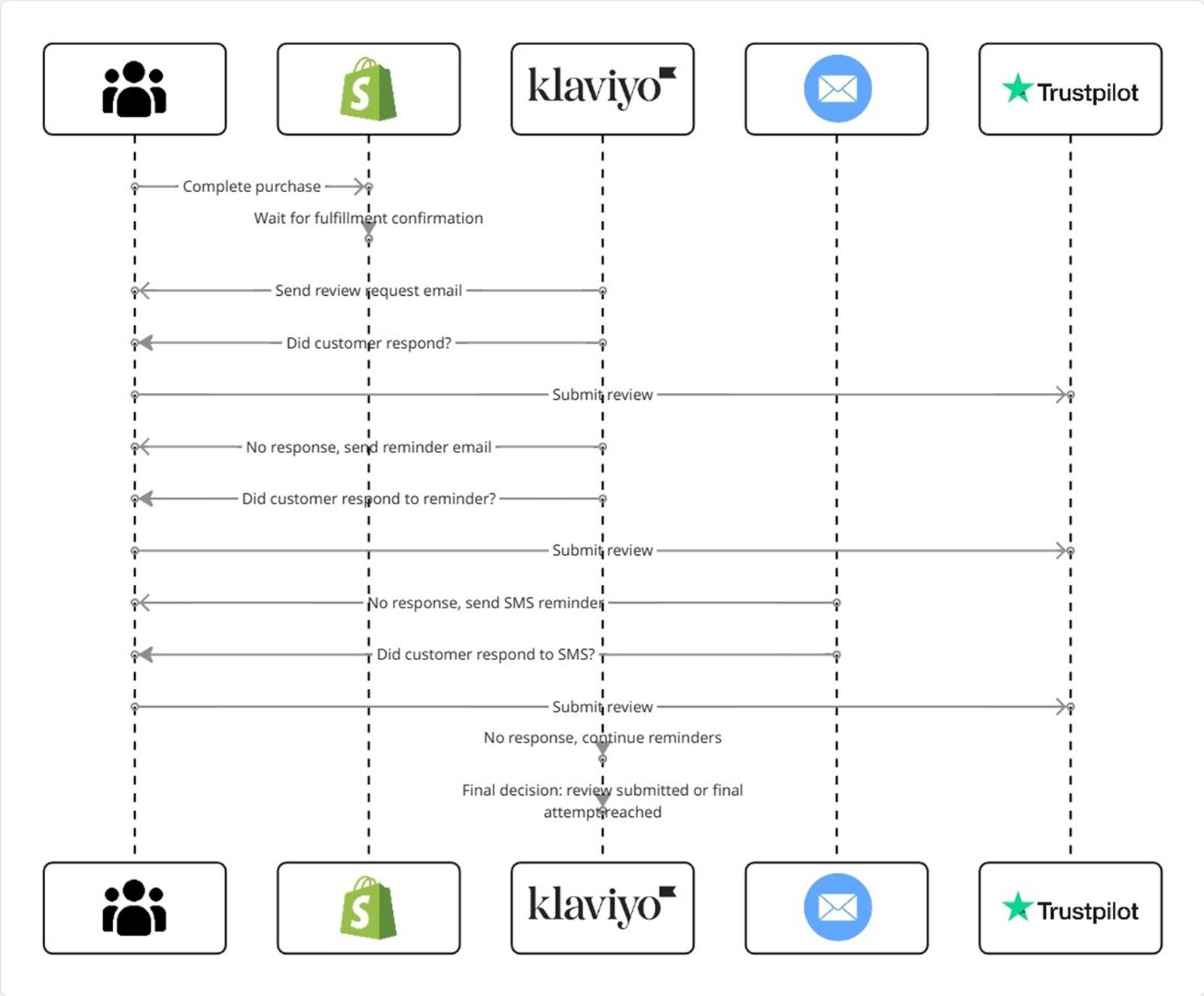
The system followed this lifecycle:
◉ 1. Customer completes purchase
◉ 2. System waits for fulfillment or delivery confirmation
◉ 3. Review request email is sent
◉ 4. If no response → reminder sequence triggered
◉ 5. SMS used as secondary channel (if email ignored)
◉ 6. Multiple reminders sent at defined intervals
◉ 7. If review submitted → sequence stops
◉ 8. If no response → sequence ends after final attempt
This ensured persistent but controlled follow-up.
6. Implementation Details
6.1 Trigger Logic
The review sequence started based on:
◉ Order fulfilled OR delivered
◉ Time delay to allow product experience
◉ Exclusion of recent reviewers
Example:
◉ Delivered + X days → Trigger review request
This ensured timing relevance.
6.2 Multi-Step Review Sequence
The sequence was structured as:
Step 1 — Initial Request
◉ Polite request
◉ Direct review link
Step 2 — Reminder 1
◉ Friendly follow-up
◉ Reinforcement of importance
Step 3 — Reminder 2
◉ Highlight benefit or appreciation
Step 4 — Final Reminder
◉ Last request before exit
Each step maintained tone variation to avoid repetition.
6.3 Email + SMS Coordination
The system used both channels strategically:
◉ Email as primary channel
◉ SMS for non-responders
◉ SMS used for higher visibility
Rules ensured:
◉ SMS not sent if email engagement detected
◉ No duplicate messaging
◉ Proper timing gaps between channels
6.4 Review Link & Tracking Logic
Each message included:
◉ Direct review link
◉ Product-specific context (if available)
◉ Tracking parameters for submission detection
This enabled accurate exit conditions.
6.5 AI Prompt (Optional Review Request Optimization)
					For message variations:
You are a customer experience specialist.

Generate a short review request message:
- Friendly tone
- Clear CTA
- Encouraging but not pushy

Avoid repetition across messages.
Keep it natural and human.
7. Score Mapping / Classification Logic
| Status | Meaning | Action |
|---|---|---|
| Pending | Review not requested yet | Await trigger |
| Requested | Initial email sent | Monitor |
| Reminder Stage | Follow-ups in progress | Continue sequence |
| Completed | Review submitted | Exit flow |
| Unresponsive | No response after sequence | End sequence |
This ensured proper flow tracking.
8. CRM / Automation Integrations
The system included:
◉ Tagging customers as “Review Requested”
◉ Tagging “Review Completed” users
◉ Excluding reviewers from future reminders
◉ Optional CRM task creation for high-value customers
◉ Integration with review platform status
This ensured accurate tracking and suppression.
9. Code-to-Business Breakdown
| System Component | Business Impact |
|---|---|
| Post-purchase trigger | Ensures every customer is targeted |
| Multi-step sequence | Increases review submission probability |
| Email + SMS coordination | Improves visibility and response rate |
| Exit logic | Prevents over-messaging |
| Review tracking | Ensures accurate reporting |
| Automation system | Removes manual outreach |
10. Real-World Brand Scenario: Deployment for Fashion Brand Alpha
Operating Environment: Fashion Brand Alpha (Pseudonym)
“Fashion Brand Alpha” is a fictional name used to represent an actual client. Certain details have been modified to preserve confidentiality.
This Specific brand operates as an e-commerce brand in the sportswear and active lifestyle category. Customer trust, product credibility, and post-purchase experience play a significant role in influencing buying decisions.
Given the competitive nature of the market, customer reviews serve as a critical trust signal—impacting both conversion rates and long-term brand perception.
How Review Collection Worked Before the System
Before the automated system was implemented:
◉ Review requests were sent inconsistently or only once after purchase
◉ No structured follow-up sequence existed
◉ Customers often forgot to leave reviews
◉ Manual outreach was limited and not scalable
◉ Many satisfied customers never submitted feedback
As a result, review volume remained low relative to the number of completed purchases.
Why the Need Became Critical
As the Brand scaled its order volume:
◉ The gap between purchases and reviews increased
◉ Social proof did not grow in proportion to customer base
◉ Potential customers lacked sufficient product validation
◉ Manual review collection could not keep pace with sales growth
◉ Opportunities to strengthen trust and credibility were missed
At this stage, review collection needed to become a structured, automated process.
How the System Was Implemented in Practice
The automated review collector engine was introduced as a post-purchase engagement layer within the customer lifecycle.
Key implementation principles included:
◉ Triggering review requests based on order delivery timing
◉ Structuring a multi-step follow-up sequence
◉ Using Email as the primary channel and SMS as a secondary channel
◉ Coordinating communication to avoid overlap or over-messaging
◉ Tracking review submissions to trigger exit conditions
◉ Ensuring consistent messaging while maintaining a natural tone
The system operated automatically for every customer, ensuring consistent coverage across all orders.
How Execution Changed After Adoption
Once deployed for this Brand:
◉ Every customer received structured review requests after purchase
◉ Follow-ups ensured multiple opportunities for response
◉ SMS increased visibility for non-responsive users
◉ Review submissions were tracked and managed automatically
◉ Manual outreach was no longer required
Review collection shifted from an inconsistent process to a system-driven lifecycle function.
11. Results & Structural Impact
Increased Review Volume
◉ More customers consistently prompted to leave reviews
◉ Higher submission rates due to structured follow-ups
Stronger Social Proof
◉ Increased number of product reviews available
◉ Improved trust and credibility for new customers
Reduced Manual Workload
◉ Eliminated need for manual review requests
◉ Fully automated review collection process
Scalable Review System
◉ Applied across all orders without additional effort
◉ Supported growth in customer volume seamlessly
12. Challenges & Adjustments
During live usage:
Timing of review requests affecting response rate
→ Adjusted trigger timing based on delivery and product usage window
Risk of over-communication
→ Implemented controlled sequence steps with clear exit logic
Low response from email-only approach
→ Introduced SMS as a secondary channel
Duplicate review requests
→ Added submission tracking and suppression rules
13. Key Learnings
◉ Review collection requires structured follow-up, not one-time requests
◉ Multi-channel communication improves response rates
◉ Timing significantly impacts customer participation
◉ Automation ensures consistent engagement across all customers
◉ Exit logic is critical to maintaining a positive customer experience
14. Conclusion
This case study demonstrates how an Automated Review Collector Engine using Email + SMS can be implemented for an e-commerce brand like Project Alpha (pseudonym) to scale review generation effectively.
By introducing a structured, multi-step post-purchase engagement system, the brand increased review volume, strengthened social proof, and transformed review collection into a reliable, automated process—without increasing operational workload.
Looking to Build a Scalable Review Collection System That Grows Social Proof Automatically?