

1. Overview
In most customer databases, a large percentage of users become inactive over time. Traditional re-engagement relies on single-channel outreach—usually email—which limits visibility and reduces recovery effectiveness.
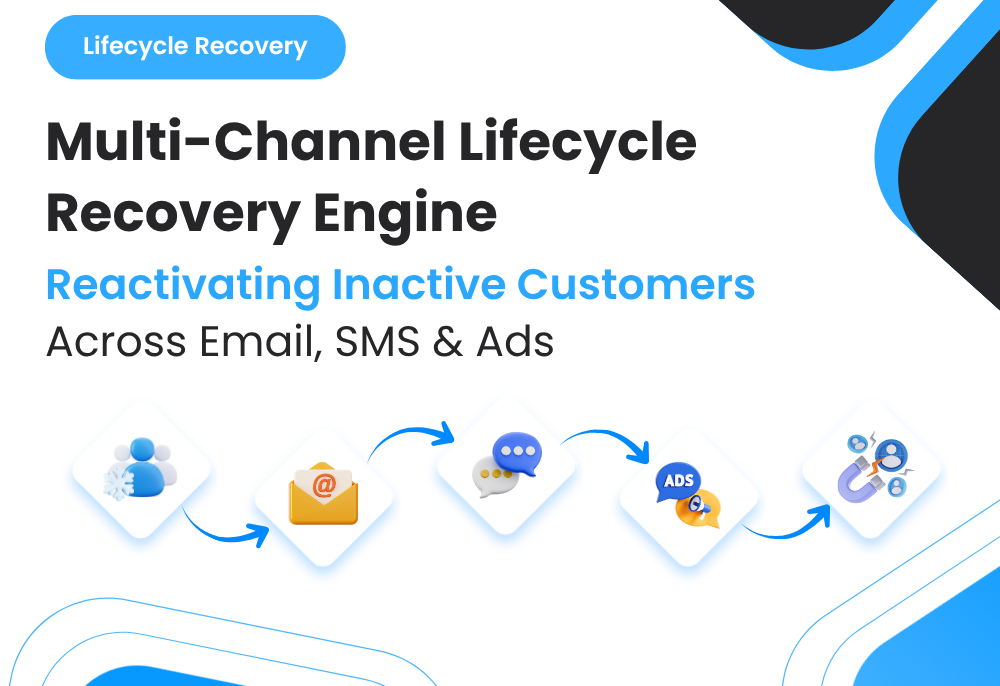
To solve this, I built a Multi-Channel Re-Engagement Automation System that targets cold customers across Email, SMS, and Paid Ads simultaneously, with messaging and channel usage adapting based on user behavior.
Instead of isolated outreach attempts, the system delivers a coordinated revival campaign, ensuring customers are reached through the most effective channel—without manual intervention.
2. Background & Context
The system was designed for:
◉ E-commerce brands
◉ Lead-generation funnels
◉ CRM-based customer databases
◉ Multi-channel marketing environments
Customer data typically included:
◉ Past purchasers
◉ Inactive subscribers
◉ Unengaged leads
◉ Lapsed high-value customers
Before automation, re-engagement relied on:
◉ Email-only campaigns
◉ Manual retargeting setup
◉ No coordination across channels
◉ Limited personalization
Cold customers remained largely unaddressed.
3. Problem Statement
The system needed to solve:
1. Low re-engagement rates from single-channel outreach
2. No unified system for cold customer recovery
3. Manual coordination between email, SMS, and ads
4. Inconsistent follow-up timing across channels
5. Lack of behavioral adaptation
The goal was to create a synchronized, behavior-driven reactivation system.
4. Tools & Automation Stack
◉ CRM / Klaviyo (customer data and segmentation)
◉ Email automation system
◉ SMS platform integration
◉ Meta Ads / Google Ads (retargeting audiences)
◉ Automation platform (Make.com / Zapier)
◉ Behavioral tracking and tagging system
This enabled cross-channel orchestration.
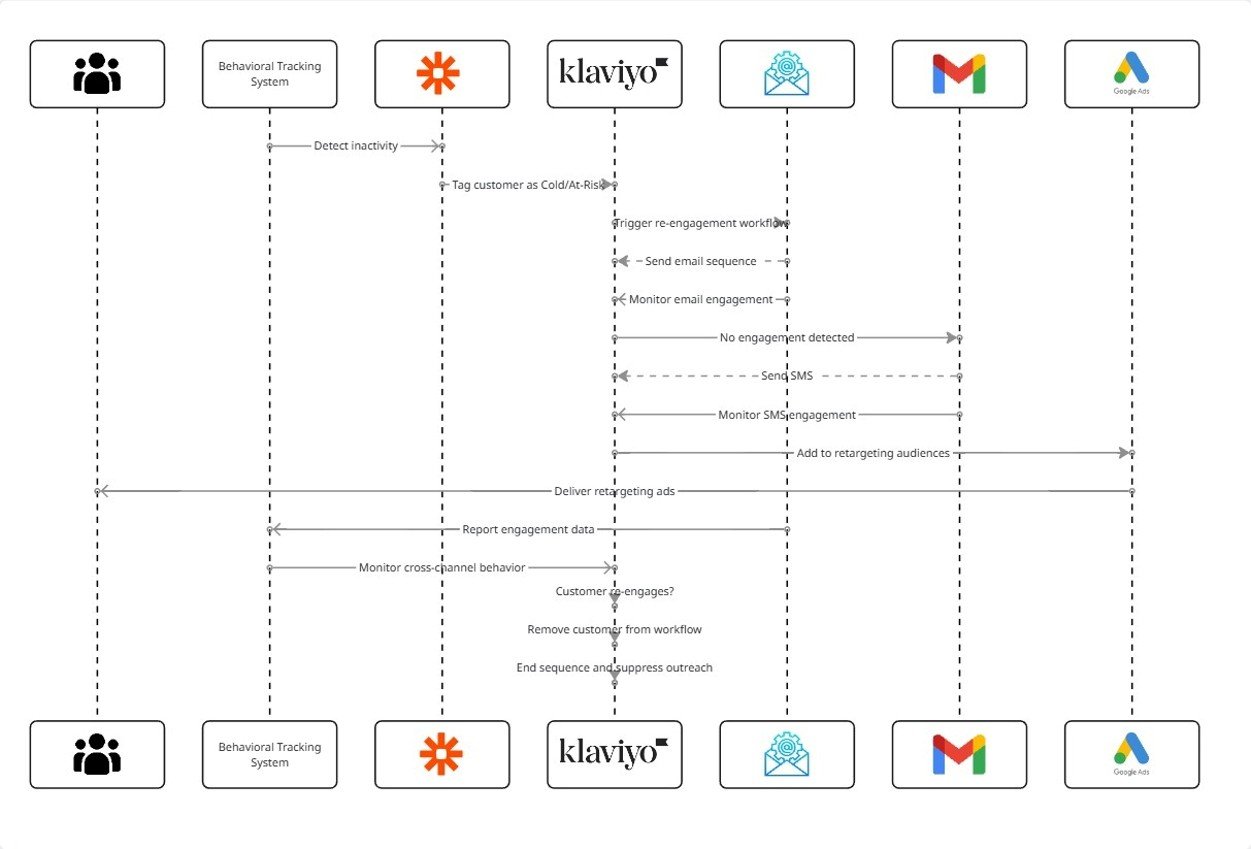
5. Automation Flow
The system followed this lifecycle:
1. Customer becomes inactive (no engagement within threshold)
2. Customer tagged as “Cold” or “At-Risk”
3. Customer enters re-engagement workflow
4. Email sequences initiated
5. SMS triggered based on non-engagement
6. Customer added to retargeting ad audiences
7. System monitors behavior across channels
8. Messaging adapts based on engagement
9. If customer re-engages → exits system
10. If no response → sequence ends or suppresses
This created a fully synchronized revival system.
6. Implementation Details
6.1 Cold Customer Identification
Customers were classified based on:
◉ No email engagement
◉ No purchases within defined period
◉ No website activity
◉ Declining interaction signals
Example:
◉ No activity for X days → At-Risk
◉ Extended inactivity → Cold
6.2 Multi-Channel Activation Logic
The system activated channels in layers:
Phase 1 — Email (Primary Channel)
◉ Initial re-engagement messaging
◉ Value-based reminders
Phase 2 — SMS (Escalation Layer)
◉ Triggered if email ignored
◉ Short, direct communication
Phase 3 — Ads (Passive Reinforcement)
◉ Customer added to retargeting audience
◉ Display ads reinforce messaging
Each channel played a defined role.
6.3 Behavioral Adaptation Logic
The system adjusted based on user actions:
◉ Email open → delay SMS
◉ Link click → prioritize email follow-up
◉ Website visit → adjust messaging
◉ Purchase → exit all flows immediately
This ensured relevance and avoided redundancy.
6.4 Messaging Strategy Structure
The sequence included:
◉ Reminder messaging
◉ Value reinforcement
◉ Incentive offers
◉ Urgency triggers
◉ Final re-engagement attempt
Each stage escalated intent.
6.5 AI Prompt (Optional Messaging Layer)
					You are a lifecycle marketing strategist.

Given:
- Customer inactivity duration
- Previous purchase behavior
- Engagement signals

Generate:
1) A re-engagement message
2) A value-based reminder
3) A clear CTA

Tone: direct, helpful, non-intrusive.
Avoid repetitive phrasing.
7. Score Mapping / Classification Logic
| Status | Meaning | Action |
|---|---|---|
| Active | Recently engaged | No action |
| At-Risk | Engagement declining | Start re-engagement |
| Cold | No engagement | Full multi-channel sequence |
| Revived | Re-engaged | Return to lifecycle flows |
| Inactive | No response after sequence | Suppress |
This created lifecycle clarity.
8. CRM / Marketing Automations
The system implemented:
◉ Tagging for inactivity levels
◉ Channel-specific triggers
◉ Retargeting audience syncing
◉ Exit conditions based on engagement
◉ Suppression for non-responsive users
This ensured coordinated execution.
9. Code-to-Business Breakdown
| System Component | Business Impact |
|---|---|
| Multi-channel activation | Increases customer reach |
| Behavioral adaptation | Improves relevance |
| Retargeting integration | Reinforces messaging passively |
| Exit logic | Prevents over-messaging |
| Automated tagging | Enables lifecycle tracking |
| Coordinated system | Removes manual effort |
10. Real-World Brand Scenario: Deployment for Fashion Brand Alpha
About Fashion Brand Alpha (Operating Environment)
“Fashion Brand Alpha” is a fictional name used to represent an actual client. Certain details have been modified to preserve confidentiality.
This Brand operates as a fashion e-commerce boutique offering curated apparel collections. The brand relies on repeat customers and returning visitors as a key driver of revenue, making customer re-engagement an essential part of the marketing strategy. As the customer base grew, a significant portion of users became inactive over time—either stopping purchases or disengaging from email and website interactions.
How Re-Engagement Worked Before the System
Before the multi-channel system was implemented:
◉ Re-engagement relied primarily on email campaigns
◉ SMS and paid ads were not coordinated with lifecycle efforts
◉ Retargeting was handled separately from CRM-based communication
◉ Follow-ups were inconsistent and not behavior-driven
◉ Many inactive customers remained unaddressed
As a result, re-engagement efforts lacked consistency and effectiveness.
Why the Need Became Critical
As the Brand scaled:
◉ The number of inactive and at-risk customers increased
◉ Email-only re-engagement showed declining effectiveness
◉ Customer churn impacted repeat purchase rates
◉ Lack of channel coordination reduced recovery potential
◉ Manual management of multiple channels was not scalable
At this stage, a unified and automated re-engagement system became necessary.
How the System Was Implemented in Practice
The multi-channel re-engagement system was introduced as a coordinated lifecycle recovery layer across Email, SMS, and Paid Ads.
Key implementation principles included:
◉ Identifying inactive and at-risk customers based on behavior
◉ Tagging customers dynamically based on engagement levels
◉ Triggering email sequences as the primary re-engagement channel
◉ Activating SMS as a secondary channel for non-responsive users
◉ Syncing customer segments with ad platforms for retargeting
◉ Adapting messaging based on cross-channel behavior signals
◉ Implementing exit logic to stop communication upon re-engagement
The system ensured that all channels worked together instead of operating independently.
How Execution Changed After Adoption
Once deployed for the Brand:
◉ Inactive customers were automatically identified and targeted
◉ Re-engagement campaigns operated across multiple channels simultaneously
◉ Messaging adapted based on user behavior and response
◉ Retargeting reinforced communication passively through ads
◉ Manual coordination between channels was eliminated
Customer recovery shifted from isolated outreach to a synchronized, system-driven process.
11. Results & Structural Impact
Improved Re-Engagement Rates
◉ Higher response compared to single-channel campaigns
◉ More inactive users returned to active status
Reduced Customer Churn
◉ At-risk customers identified earlier
◉ Increased recovery before long-term inactivity
Better Channel Utilization
◉ Email, SMS, and Ads used strategically
◉ Reduced inefficiencies in communication
Scalable Recovery System
◉ Applied across the entire customer base
◉ Operated without manual coordination
12. Challenges & Adjustments
During live usage:
Channel overlap and message fatigue
→ Implemented conditional triggers and timing gaps
Tracking cross-channel engagement accurately
→ Introduced unified tagging and behavior tracking
Ad audience syncing delays
→ Applied scheduled refresh cycles
Workflow complexity
→ Structured system into clear phases with defined roles per channel
13. Key Learnings
◉ Re-engagement requires a multi-channel approach
◉ Behavioral adaptation significantly improves effectiveness
◉ Channel coordination is essential for consistent communication
◉ Automation ensures continuous recovery efforts
◉ Lifecycle systems must include structured reactivation stages
14. Conclusion
This case study demonstrates how a Multi-Channel Re-Engagement Automation System using Email, SMS, and Ads can be implemented for a fashion e-commerce brand like Project Alpha (pseudonym) to recover inactive customers at scale.
By synchronizing multiple channels and adapting messaging based on behavior, the system transformed re-engagement into a structured, automated lifecycle process—improving recovery rates, reducing churn, and enabling scalable customer retention without increasing operational complexity.
Trying to Turn Customer Re-Engagement Into an Automated Lifecycle Recovery System?