

1. Overview
Weekly email production—especially for fashion and retail brands—requires assembling products, writing copy, designing layouts, and coordinating timing. This process is repetitive, time-sensitive, and often creates bottlenecks between merchandising, design, and marketing teams.
To streamline this, I built an Automated Capsule Email Production Workflow that pulls product data, images, and content into a predefined layout and generates a fully structured email draft.
Instead of building emails manually each week, PMs only review, approve, and schedule—turning email production into a controlled, scalable system.
2. Background & Context
The system was designed for:
◉ Fashion brands with weekly drops
◉ Retail businesses with frequent product updates
◉ Email-driven engagement strategies
◉ Klaviyo or ESP-based campaign systems
Typical workflow before automation:
◉ Selecting products manually
◉ Collecting images and links
◉ Writing product descriptions
◉ Designing layouts
◉ Formatting emails
◉ Reviewing and sending
This process required coordination across multiple roles.
3. Problem Statement
The email production process had several inefficiencies:
1. Manual assembly of weekly emails
2. Dependency on design and content teams
3. Inconsistent structure across campaigns
4. Time pressure for weekly drops
5. High operational overhead for repetitive tasks
The system needed to standardize and automate email production while preserving flexibility.
4. Tools & Automation Stack
◉ Shopify (product data source)
◉ Klaviyo / ESP (email delivery platform)
◉ Product feed or API integration
◉ Template system (modular email layouts)
◉ Automation platform (Make.com / Zapier)
◉ Image and asset management
◉ Optional: AI for copy generation
This allowed dynamic email generation.
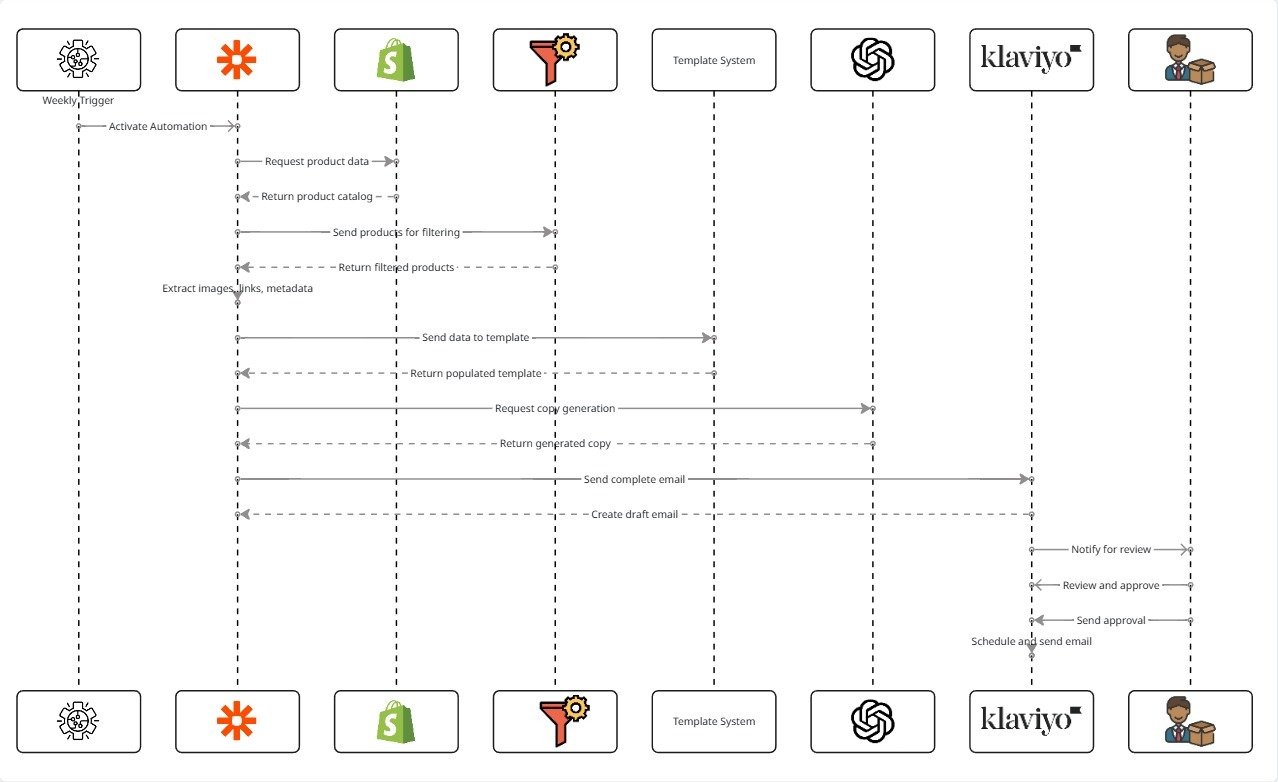
5. Automation Flow
The system followed this process:
1. Weekly trigger activates workflow
2. Product data pulled from Shopify
3. Selected products filtered based on rules
4. Images, links, and metadata extracted
5. Email template populated automatically
6. Copy generated or inserted
7. Draft email created in ESP
8. PM reviews and approves
9. Email scheduled and sent
This eliminated manual production steps.
6. Implementation Details
6.1 Product Selection Logic
Products were selected based on:
◉ New arrivals
◉ Featured collections
◉ Inventory availability
◉ Manual override (optional)
Example rules:
◉ Products added within last X days
◉ Products tagged for campaign inclusion
This ensured relevance for weekly drops.
6.2 Template Structure System
The email used modular blocks:
◉ Header (branding)
◉ Featured products section
◉ Supporting product grid
◉ CTA section
◉ Footer
Templates ensured:
◉ Consistent layout
◉ Faster generation
◉ Minimal design dependency
6.3 Data Mapping Logic
Each product block included:
◉ Product image
◉ Product name
◉ Price
◉ Link
◉ Optional description
All data was mapped automatically from Shopify.
6.4 Copy Generation Logic
Copy was generated or inserted using:
◉ Predefined templates
◉ Product metadata
◉ Optional AI generation
Example AI prompt:
					You are a fashion email copywriter.

Given:
- Product names
- Collection theme
- Brand tone

Generate:
1) A short intro line
2) Product highlights
3) A CTA line

Tone: stylish, concise, brand-aligned.
6.5 Draft Generation in ESP
The system created:
◉ Pre-filled email draft
◉ Structured layout with all products
◉ Ready-to-send format
PM only needed to:
◉ Review
◉ Adjust (if necessary)
◉ Schedule
7. Score Mapping / Classification Logic
Email readiness was classified as:
| Status | Meaning | Action |
|---|---|---|
| Draft Generated | Email created automatically | Await review |
| Ready | Approved by PM | Schedule |
| Needs Edit | Minor adjustments required | Update before send |
| Scheduled | Email queued | No action |
This ensured workflow clarity.
8. CRM / ESP Automations
The system included:
◉ Automatic draft creation
◉ Tagging campaigns by type (capsule / drop)
◉ Scheduling triggers
◉ Product tagging for tracking
◉ Campaign performance linkage
This connected production with execution.
9. Code-to-Business Breakdown
| System Component | Business Impact |
|---|---|
| Product data pull | Eliminates manual product selection |
| Template system | Standardizes email structure |
| Auto population logic | Reduces assembly time |
| Copy automation | Removes writing bottleneck |
| Draft generation | Speeds up production cycle |
| Approval workflow | Keeps PM control intact |
10. Real-World Brand Scenario: Deployment for Project Nova (Pseudonym)
About Project Nova (Operating Environment)
Project Nova is a pseudonym used to protect the confidentiality of the original client. The strategies, workflows, and outcomes presented are based on real project experience, while identifying brand assets and confidential information have been modified or omitted.
This Specific Brand operates as a fashion e-commerce brand with frequent product drops and a strong reliance on email marketing to drive engagement and sales. Weekly campaigns—especially capsule-style product highlights—play a key role in showcasing new arrivals and maintaining consistent communication with the audience. Given the volume of products and the cadence of weekly campaigns, email production required coordination across merchandising, design, and marketing functions.
How Email Production Worked Before the System
Before the automated workflow was implemented:
◉ Products were selected manually for each campaign
◉ Images, links, and details were collected across multiple sources
◉ Copywriting and layout creation required separate steps
◉ Email design depended on coordination with design resources
◉ Weekly campaigns were built from scratch each time
This process created delays, increased dependency on multiple roles, and made it difficult to maintain consistency.
Why the Need Became Critical
As this Brand scaled product volume and campaign frequency:
◉ Weekly email production became time-sensitive and repetitive
◉ Manual assembly created bottlenecks across teams
◉ Inconsistent layouts affected brand presentation
◉ PMs spent significant time coordinating rather than optimizing
◉ Scaling campaign frequency required a more efficient system
At this stage, email production needed to transition from manual execution to a structured system.
How the System Was Implemented in Practice
The automated capsule email production workflow was introduced as a data-driven content generation layer integrated with Shopify and the ESP (Klaviyo).
Key implementation principles included:
◉ Pulling product data automatically from Shopify
◉ Applying rule-based product selection for weekly drops
◉ Using modular templates to standardize email layout
◉ Auto-populating product images, links, and metadata
◉ Generating or inserting copy using predefined logic
◉ Creating ready-to-send drafts inside the email platform
◉ Maintaining a review-and-approval step for control
The system ensured that email production was automated while still allowing final human validation.
How Execution Changed After Adoption
Once deployed for the Brand:
◉ Weekly emails were generated automatically within minutes
◉ Product selection and content assembly became system-driven
◉ Email layouts remained consistent across all campaigns
◉ PMs focused on review and scheduling instead of building
◉ Dependency on design and content teams was significantly reduced
Email production shifted from a manual workflow to a scalable, automated system.
11. Results & Structural Impact
Faster Email Production
◉ Weekly campaigns created in minutes instead of hours
◉ Reduced turnaround time for campaign launches
Consistent Campaign Structure
◉ Uniform layout across all email campaigns
◉ Improved visual and structural consistency
Reduced Operational Load
◉ Minimal manual effort required from PMs
◉ Elimination of repetitive production tasks
Scalable Email System
◉ Supported increasing product volume and campaign frequency
◉ Enabled consistent execution without additional resources
12. Challenges & Adjustments
During live usage:
Product selection relevance issues
→ Implemented rule-based filtering with optional manual override
Template rigidity concerns
→ Introduced modular blocks for flexibility
Copy consistency across campaigns
→ Used structured templates with optional AI enhancement
Asset mismatches from product data
→ Standardized product data structure and validation
13. Key Learnings
◉ Repetitive production workflows should be automated
◉ Templates are essential for scalable content creation
◉ Data-driven systems reduce manual dependency
◉ Approval workflows maintain quality control
◉ Automation improves consistency across campaigns
14. Conclusion
This case study demonstrates how an Automated Capsule Email Production Workflow can be implemented for a fashion e-commerce brand like Project Nova (Pseudonym) to streamline weekly campaign execution.
By automating product selection, content assembly, and draft generation, the system transformed email production into a structured, scalable process—allowing teams to focus on strategy while maintaining consistency and speed without increasing operational complexity.
Planning to Build an Automated Email Production System for Your E-Commerce Brand?