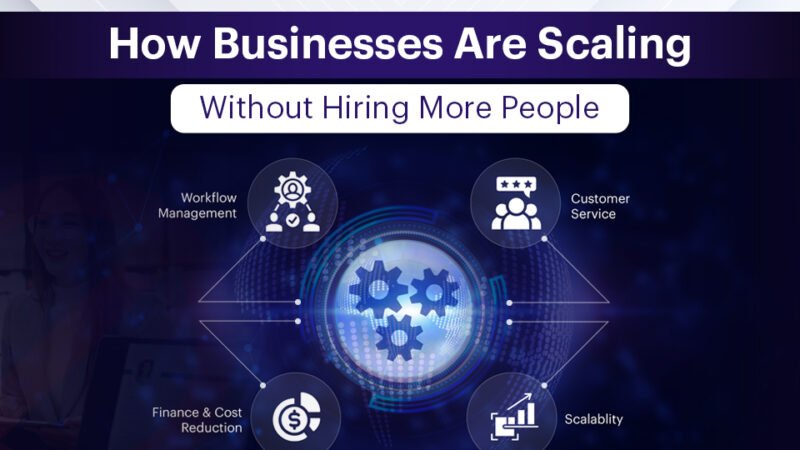
The ROI of Automation: How Businesses Scale Without Hiring More People
Across nearly every industry, one pattern has become increasingly clear: Businesses are scaling faster than ever—without increasing headcount.
Instead of relying on larger teams, companies are investing in smarter systems. Automation has evolved from a “nice-to-have” efficiency tool into a core growth strategy, enabling organizations to streamline workflows, reduce manual effort, and achieve more with the same number of people. But the most important question leaders ask is simple:
What is the real ROI of automation—and why are so many businesses choosing it over hiring?
This article breaks down the financial, operational, and strategic returns automation delivers—and why it has become one of the highest-ROI investments modern businesses can make.
1. Reducing Operational Costs Without Sacrificing Output
Hiring employees comes with long-term financial commitments: salaries, onboarding, benefits, training, and ongoing overhead. Automation removes many of these recurring costs by handling work that previously required manual labor.
A key benefit is improved operational efficiency, which research shows is a primary driver of sustainable cost reduction.
Automation helps teams:
Complete tasks faster
Reduce human error
Operate consistently 24/7
Eliminate task switching
Remove repetitive manual processes
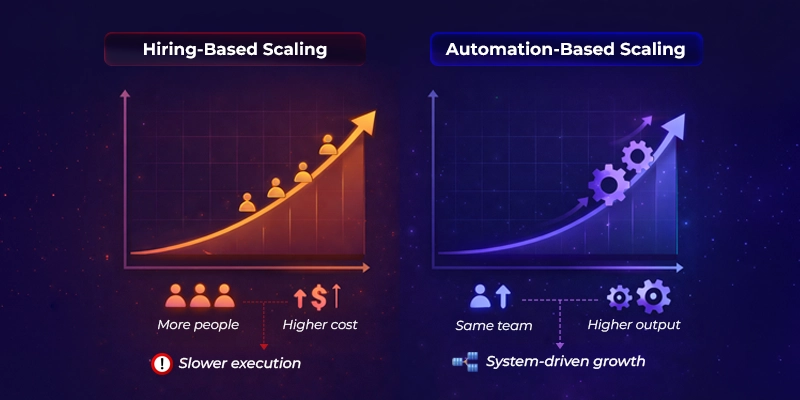
Instead of scaling payroll, businesses scale output.
Example: A company that once required three employees to handle lead entry, follow-ups, and reporting can automate all three—reducing labor costs for that function by up to 60–70%. Small automations compound into major savings over time.
2. Faster Execution Improves Business Scalability
Traditionally, growth meant hiring more people. Today, businesses scale through systems. Automation accelerates scalability by enabling process automation, which reduces cycle times and increases throughput.
With automation, businesses can:
Process more leads
Manage more customers
Produce more content
Fulfill more orders
Run more campaigns
—all without increasing team size.
This is why automation is often described as a scaling multiplier rather than a cost-saving tool.
3. Better Customer Experiences With Less Manual Work
Modern customers expect fast, consistent, and personalized experiences. Automation delivers all three—without increasing workload. By leveraging tools likecustomer journey mapping, businesses can design automated paths that adapt to customer behavior and intent.
Automation enables:
Instant responses to inquiries
Seamless onboarding flows
Personalized recommendations
Perfectly timed follow-ups
24/7 customer support
These experiences once required large support teams. Today, automation executes them reliably at scale.
ROI impact includes:
Higher customer retention
Increased lifetime value (LTV)
More repeat purchases
Improved customer satisfaction
4. Eliminating Human Error Improves Consistency
Manual processes inevitably introduce errors: missed follow-ups, incorrect data entry, inconsistent messaging, and forgotten tasks. Automation eliminates these risks by executing workflows the same way every time. Studies on workflow standardization show that automation dramatically improves consistency by removing human variability.
Why this matters for ROI:
Fewer errors = less rework
Consistent quality = stronger trust
Reliable processes = repeatable revenue
Automation delivers dependable outcomes without constant supervision.
5. Increasing Employee Productivity Without Burnout
Automation doesn’t replace employees—it empowers them. When teams aren’t stuck doing repetitive tasks, they can focus on strategic, creative, and revenue-driving work. Research on workforce productivity shows that automation allows employees to contribute more value without increasing stress.
Automation improves productivity by:
Reducing task-switching fatigue
Eliminating manual admin work
Allowing larger workloads to be managed efficiently
Providing real-time system insights
ROI insight: One employee supported by automation can often perform the work of three—not through overwork, but through better systems.
6. Enabling Data-Driven Decision Making
One of automation’s most underestimated benefits is data collection.
Automated systems track:
Performance metrics
Customer behavior
Conversions and revenue
Funnel drop-offs
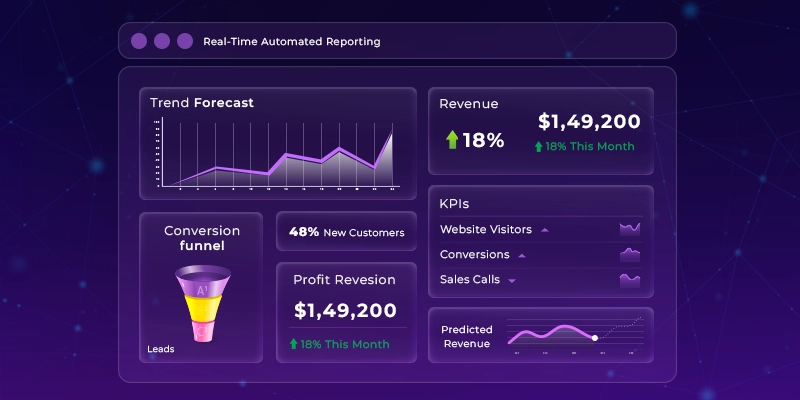
This data fuels predictive analytics, which improve forecasting accuracy and decision-making.
Benefits include:
Faster reporting cycles
More accurate forecasts
Better budget allocation
Real-time operational adjustments
Automation doesn’t just save money—it amplifies intelligence.
This compounding effect is why automation often delivers ROI far beyond traditional investments.
Returns appear in:
Labor cost reduction
Faster delivery timelines
Higher customer retention
Increased conversion rates
Lower overhead
Stronger team productivity
8. Scaling Without Hiring Creates Competitive Advantage
Businesses that scale through automation gain clear advantages:
Lower operating costs
Faster time-to-market
Higher output per employee
More resilient workflows
Reduced operational complexity
In competitive markets, automation becomes one of the few sustainable ways to grow without burning resources or burning out teams.
Final Thoughts
Automation has evolved into a growth engine, not just a productivity tool.
It delivers measurable ROI through:
Cost reduction
Higher output
Better customer experiences
Improved decision-making
Most importantly, automation enables businesses to scale without hiring more people—creating leaner operations, stronger margins, and long-term competitive advantage. The businesses that invest in automation today will become the category leaders of tomorrow.
Marketing Automation Mistakes You Must Avoid (and How to Fix Them)
Marketing automation is one of the most powerful systems a modern business can implement. When done right, it saves time, nurtures leads automatically, personalizes communication at scale, and creates consistent customer experiences without constant manual effort. But here’s the reality:
Most businesses are using marketing automation incorrectly. Instead of driving growth, poorly designed automations quietly damage engagement, reduce trust, and leave revenue on the table. The problem isn’t automation itself—it’s how it’s implemented.
Understanding these mistakes, and knowing how to fix them, is essential for building automation systems that actually support growth instead of creating friction. Below are the most common marketing automation mistakes and how to correct them.
1. Automating Without a Clear Strategy
Many businesses jump into automation tools without a clear plan. They build workflows that overlap, contradict each other, or trigger at the wrong moments. This usually happens when teams skip the foundational step of designing automation workflows—clearly mapping triggers, actions, and conditions before implementation.
Without strategy, automation becomes chaotic instead of efficient.
How to fix it:
Define one clear goal per automation
Map the customer journey manually first
Build and test one workflow at a time
A clear strategy ensures automations work together—not against each other.
2. Over-Automating Everything
Not every interaction should be automated. One of the fastest ways to damage trust is removing human judgment from moments that require empathy or nuance. This often happens when teams misunderstand the purpose of marketing automation systems, which are meant to support communication—not replace relationships.
When everything feels automated, your brand starts to feel robotic.
How to fix it:
Keep human involvement where personalization matters
Automate predictable, repetitive tasks only
Use automation to assist—not replace—people
Efficiency without empathy creates distance.
3. Poor Segmentation
One of the biggest automation killers is treating all contacts the same. Sending identical messages to everyone leads to:
Low engagement
High unsubscribe rates
Misaligned messaging
Effective automation depends on marketing segmentation, which groups users based on behavior, interest, and lifecycle stage. Without segmentation, automation amplifies irrelevance.
How to fix it:
Segment by behavior and engagement
Segment by lifecycle stage
Use dynamic, real-time conditions
Relevant messaging always outperforms volume.
4. Ignoring Performance Analytics
Marketing automation is not a “set and forget” system. Customer behavior changes, markets evolve, and workflows degrade over time. Many businesses neglect automation analytics, which reveal where users drop off, disengage, or stop converting.
Without measurement, automation can quietly fail for months.
How to fix it:
Review automation performance monthly
A/B test subject lines and content
Update outdated triggers and messages
Automation should evolve alongside your audience.
5. Using Dirty or Inaccurate Data
Automation is only as effective as the data powering it. Duplicate contacts, incorrect fields, and incomplete records break:
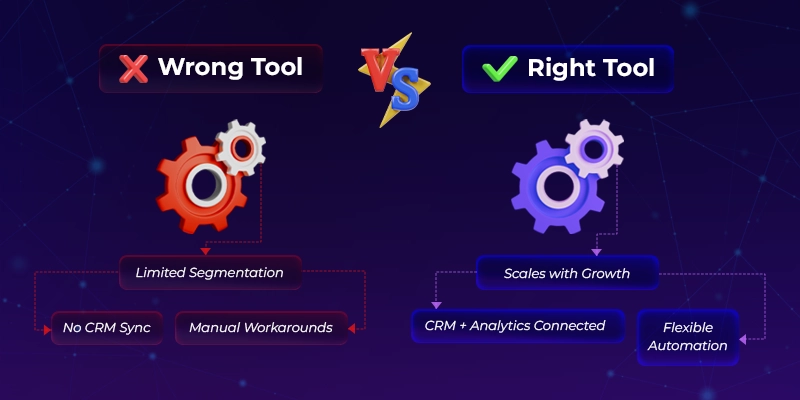
Many businesses choose automation tools based on price instead of fit. The result is limited segmentation, poor reporting, and weak integrations. Before committing, it’s important to evaluate marketing automation platforms based on scalability, features, and ecosystem compatibility.
The wrong tool adds friction instead of removing it.
How to fix it:
Identify non-negotiable features first
Ensure CRM and analytics integration
Choose tools that grow with your business
The right platform simplifies everything downstream.
True personalization goes beyond name tokens. It includes:
Behavior-based timing
Dynamic content blocks
Context-aware messaging
Automation should adapt to users, not force users into rigid sequences.
How to fix it:
Trigger messages based on actions, not schedules alone
Customize content using interest and behavior data
Continuously refine personalization logic
When automation feels human, customers respond.
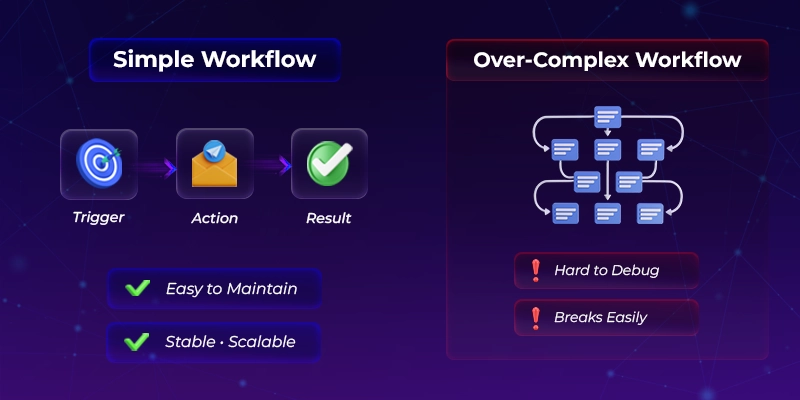
8. Building Overly Complex Workflows Too Soon
Beginners often create large, multi-branch automations that are hard to debug and maintain. When something breaks, no one knows why.
How to fix it:
Start with simple workflows (welcome, re-engagement)
Add complexity only when needed
Document every automation clearly
Stable systems outperform complicated ones.
9. Poor Alignment Between Sales and Marketing
Automation should connect sales and marketing—not create silos. When teams disagree on lead scoring, handoff timing, or lifecycle stages, automation breaks silently.
How to fix it:
Define shared lifecycle stages
Sync CRM fields across teams
Review handoff rules regularly
Alignment turns automation into a growth engine.
10. Forgetting the Human Touch
Automation accelerates repetitive tasks—but it cannot replace empathy, judgment, or trust. The most effective systems leave room for humans to intervene when it matters.
How to fix it:
Add manual checkpoints for high-value moments
Allow overrides for sales or support teams
Use automation to enhance—not erase—human connection
Automation works best when it feels invisible.
Final Thoughts
Marketing automation is powerful—but only when implemented with intention. By avoiding these common mistakes and applying the fixes above, businesses can build automation systems that:
Improve customer experience
Increase conversions
Save time without losing trust
Automation should make your marketing smarter—not louder.
10 Everyday Business Tasks You Can Automate Right Now (and Save 10+ Hours a Week)
In today’s fast-paced business environment, the difference between growth and stagnation often comes down to how effectively time and effort are managed. Many teams work long hours, yet a large portion of that time is consumed by repetitive, low-value tasks.
This is where automation makes a measurable difference.
By automating the right everyday business tasks, teams can reclaim hours each week and redirect that time toward strategy, creativity, and customer impact. Automation is no longer reserved for large enterprises—it’s now accessible, affordable, and practical for small and mid-sized businesses.
At THRayvee, we focus on building smart workflows that remove friction from daily operations. Below are 10 everyday business tasks you can automate right now to realistically save 10+ hours per week—without adding complexity.
Why Automate Everyday Business Tasks?
Before diving into the list, it’s important to understand why automation delivers such strong returns.
Business process automation isn’t about replacing people—it’s about removing repetition. When routine tasks are handled by systems, businesses benefit from:
Increased productivity through faster execution
Higher accuracy and consistency with fewer human errors
More time for high-value work like planning and decision-making
Better scalability without proportional increases in workload
In short: automate the mundane so people can focus on what actually drives growth.
1. Email Follow-Ups and Lead Nurturing
Sales and customer-facing teams spend a surprising amount of time sending follow-ups, reminders, and check-in emails.
Automation allows you to:
Trigger follow-ups based on user actions
Schedule nurture sequences automatically
Log interactions directly into your CRM
Notify internal teams when leads go cold
This keeps conversations moving without constant manual effort and reduces missed opportunities.
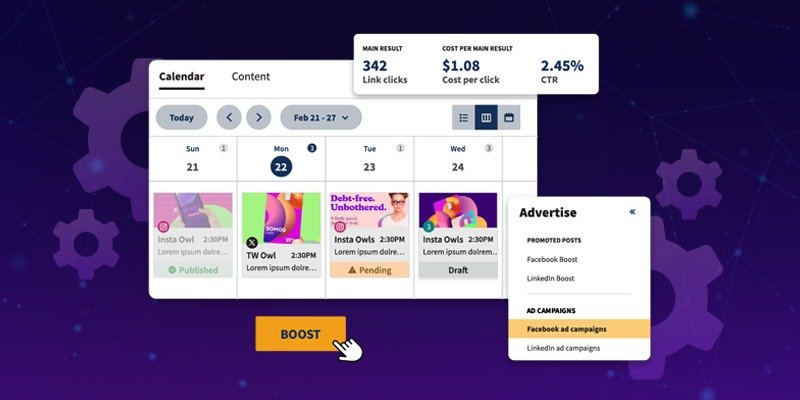
2. Social Media and Content Scheduling
Posting content manually is distracting and inconsistent. Automation allows teams to batch work and stay visible without daily interruptions.
You can automate:
Content scheduling across platforms
Optimal posting times
Re-sharing evergreen content
Distribution of blog links and updates
Social scheduling is widely recognized as a high-impact automation opportunity for small teams.
3. Generating and Distributing Reports
Reports often require repetitive data collection, formatting, and sharing. This is one of the most time-intensive manual processes in many businesses.
Automation enables you to:
Pull data from multiple systems automatically
Generate standardized reports or dashboards
Send reports to stakeholders on a fixed schedule
Automated reporting improves visibility while eliminating manual overhead.
4. Invoice Processing and Expense Approvals
Finance workflows are highly repetitive and rule-based—making them ideal for automation.
You can automate:
Invoice data extraction
Approval routing based on rules
Payment reminders and status updates
Ledger or accounting system updates
This reduces processing time and minimizes costly errors.
5. Employee Onboarding and Offboarding
Onboarding new hires involves many repeatable steps: account creation, access provisioning, training assignments, and documentation.
Automation helps by:
Triggering onboarding workflows automatically
Creating accounts and assigning tools
Sending welcome resources and checklists
Revoking access during offboarding
HR automation improves both efficiency and employee experience.
6. Customer Support Ticket Routing
Customer service teams often spend unnecessary time sorting, assigning, and escalating tickets.
Automation allows:
Automatic ticket categorization
Smart assignment based on issue type
Pre-written responses for common questions
Escalation rules for unresolved cases
This improves response time and helps teams scale without adding headcount.
7. Review and Feedback Collection
Requesting reviews manually is inconsistent and often forgotten.
Automation can:
Trigger review requests after key events
Send reminders if no response is received
Aggregate feedback into a central dashboard
Consistent feedback collection strengthens social proof without additional effort.
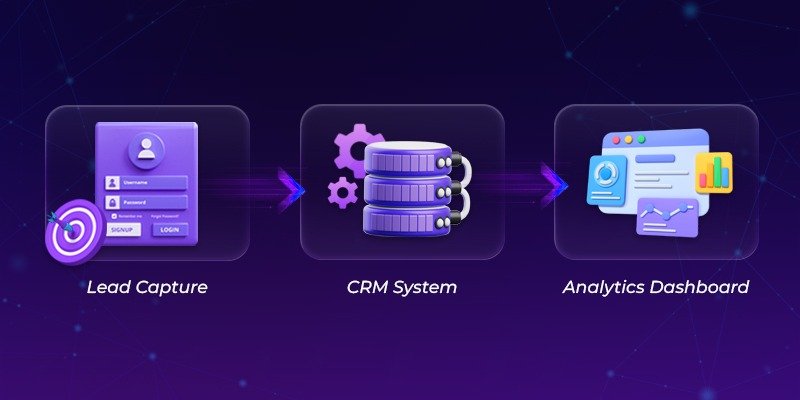
8. Data Entry and CRM Updates
Manual data entry is slow, error-prone, and frustrating.
Automation enables:
Automatic lead capture from forms and ads
Data validation and de-duplication
Real-time CRM updates based on actions
Clean, accurate data improves reporting and sales performance.
9. Appointment Scheduling and Calendar Management
Back-and-forth emails to find meeting times waste hours every week.
Automated scheduling tools:
Show real-time availability
Send confirmations and reminders
Create calendar events automatically
Trigger follow-up workflows
Scheduling automation is one of the fastest ways to reclaim time.
10. Workflow Alerts and Task Reminders
Small reminders often prevent big problems.
You can automate alerts for:
Pending approvals
Contract renewals
Missed deadlines
Performance thresholds
These micro-automations prevent bottlenecks and reduce manual chasing.
This approach reflects how workflow automation improves consistency and execution speed.
How to Get Started With Automation
Knowing what to automate is only half the work. Execution matters.
Start small Pick one repetitive task with clear steps.
Map the current process Document how the task works today before automating it.
Choose practical tools Many automations can be built with low-code or built-in workflows.
Test and refine Monitor time saved, errors reduced, and team adoption.
Measure impact Track hours saved and operational improvements.
Train your team Automation works best when people understand and trust the system.
Why Saving 10+ Hours a Week Matters
Saving 10 hours per week translates into:
One full workday reclaimed every week
Over 500 hours per year redirected to growth
Less burnout and fewer errors
More consistent operations
Research consistently shows that automation-driven organizations outperform peers in efficiency and scalability.
Final Thoughts
Automation isn’t about working harder—it’s about working smarter.
By automating everyday tasks like follow-ups, reporting, onboarding, scheduling, and reminders, businesses can save significant time, reduce errors, and scale operations without increasing effort.
Start with one task. Automate it well. Then build from there.
Beyond Buzzwords: Practical SEO Tactics You’ll Need to Rank in 2026
In the ever-evolving world of SEO, staying on top of trends and updates is key to maintaining visibility and competitiveness. But in 2026, ranking high on search engines requires more than just keeping up with buzzwords or surface-level tactics; it’s about implementing practical, user-centered strategies that align with how people search, engage, and interact online.
The days of simple keyword stuffing and quick-fix techniques are over. Now, Google and other search engines prioritize sites that truly serve their users with valuable, accessible, and optimized content. The focus has shifted to creating a seamless user experience, meeting search intent, and delivering meaningful engagement. Below are essential strategies designed to improve your rankings while building an SEO-friendly website that attracts, retains, and resonates with users in a way that drives long-term results.
1. Optimize for Search Intent, Not Just Keywords
Gone are the days of stuffing keywords into content. In 2026, search intent is the backbone of effective SEO. Google prioritizes results that answer users’ actual questions, so aligning your content with intent is essential.
Understanding Intent: Recognize whether a keyword implies informational, transactional, or navigational intent, and tailor your content to meet this specific need. For example, informational keywords might include “how to,” while transactional keywords indicate buying intent, like “best deals on laptops.”
Create Solution-Based Content: Develop articles, guides, or tools that directly address user problems. A user searching for “how to rank higher on Google” expects actionable steps and expert advice, not general information.
Use Intent-Specific Keywords: Target keywords that align with the user’s purpose, such as “best” for reviews or “how to” for guides. Matching keywords to intent not only increases engagement but also signals relevance to search engines, enhancing rankings.
Focus on Long-Tail Keywords: Long-tail keywords are often more specific and align closely with user intent. Phrases like “SEO for small businesses in 2024” help attract a well-defined audience looking for particular information, which can improve engagement and conversions.
2. Embrace E-A-T: Expertise, Authoritativeness, and Trustworthiness
E-A-T—Expertise, Authoritativeness, and Trustworthiness—continues to be a crucial ranking factor, particularly in sensitive fields like finance, health, and law. Establishing credibility within your niche can boost your SEO significantly.
Showcase Author Credentials: Include author bios with relevant qualifications and credentials, and link to reputable sources to reinforce credibility and trust.
Publish Well-Researched Content: Invest time in creating valuable, accurate, and research-based content. Conduct thorough research, use credible sources, and focus on actionable insights rather than fluff.
Build Trust through Backlinks from Reputable Sites: Secure backlinks from respected sites within your industry. Backlinks signal authority and trustworthiness to search engines, improving your E-A-T score.
Consistently Update Content: Regularly update older posts with new data and insights to keep content relevant and maintain trust with your audience and search engines alike.
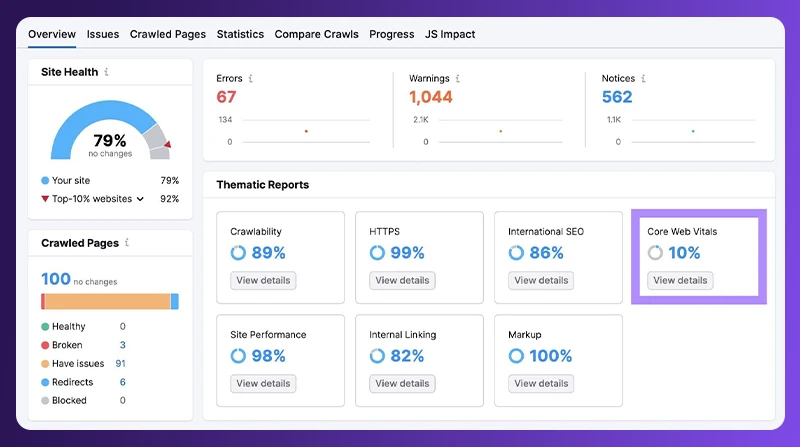
3. Prioritize Core Web Vitals for a Smooth User Experience
User experience has become a central ranking factor, and Google’s Core Web Vitals—loading speed, interactivity, and visual stability—are key indicators of user satisfaction.
Optimize Loading Speed: Compress images, use a content delivery network (CDN), and reduce unnecessary scripts to ensure fast loading times, ideally under three seconds, to improve SEO and user satisfaction.
Ensure Visual Stability: Use proper dimensions for images and embeds to prevent unexpected layout shifts. A stable site keeps users engaged and reduces bounce rates.
Enhance Mobile Usability: With mobile users on the rise, optimizing for mobile-first experience is essential. Mobile-friendly designs, readable text, and intuitive navigation help reduce bounce rates and improve SEO.
Boost Interactivity with Quick Loading Elements: Reduce server response times and improve interactive elements for a smoother browsing experience. Tools like Lighthouse can help identify slow-loading elements that may hinder performance.
4. Enhance Content with Visuals and Multimedia
Text is essential, but multimedia content engages users more effectively, positively impacting SEO metrics like dwell time and bounce rate.
Add Relevant Visuals: Include images, graphs, and illustrations that support your content. Visuals add depth, clarify complex information, and keep users engaged longer.
Optimize Video Content: Videos are highly engaging and can drive traffic from platforms like YouTube. Embedding relevant videos on your pages can enhance user engagement and retention on your site.
Use Alt Text for Accessibility and SEO: Alt text helps search engines understand images and improves accessibility for visually impaired users, making your site more inclusive and SEO-friendly.
Create Interactive Content: Tools like calculators, quizzes, and infographics can encourage users to spend more time on your page, improving SEO metrics while providing added value to your audience.
5. Implement a Topic Cluster Strategy
In 2026, topic clusters are still a powerful way to establish authority by organizing content around central themes and topics.
Create a Comprehensive Pillar Page: Start with a detailed pillar page on a broad topic, such as “Digital Marketing 101,” that links to specific, supporting content pages.
Develop Supporting Content: Write articles on related subtopics like “SEO Basics,” “Content Marketing Strategy,” and link them back to the pillar page, creating a cohesive content cluster.
Enhance Internal Linking Structure: Use internal links between pillar pages and cluster content to help search engines navigate your site and understand topic relevance and authority.
Refresh Topic Clusters Regularly: Update pillar and cluster content with fresh insights to maintain relevance and authority in your niche over time.
6. Improve Local SEO with Google Business Profile Optimization
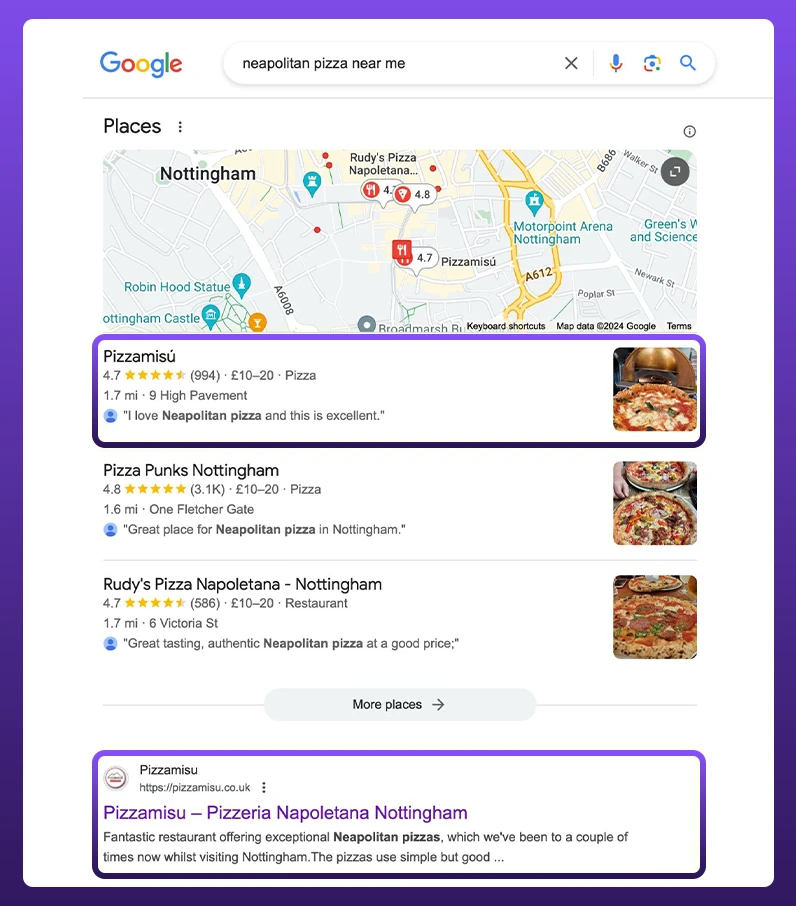
For local businesses, optimizing for local SEO on platforms like Google Business Profile is crucial for driving local traffic and increasing visibility.
Complete Your Profile with Accurate Information: Ensure your profile includes up-to-date business hours, descriptions, and photos of your products or location to help customers understand your offerings.
Encourage Positive Customer Reviews: Ask satisfied customers to leave reviews and respond to each one to show engagement, build credibility, and use customer feedback to improve.
Add Location-Specific Keywords: Use keywords related to your city, neighborhood, or service area within your profile and site content to improve your visibility in local searches.
Use Google Posts for Engagement: Google Posts allow you to share updates, promotions, and events directly on your profile, keeping potential customers informed and engaged.
7. Utilize Structured Data for Rich Results
Structured data markup (schema) helps search engines interpret your content accurately, increasing the likelihood of rich results that stand out in search listings.
Implement FAQ and How-To Schema: Use schema for FAQ or how-to content to make your page eligible for rich snippets, which can increase click-through rates.
Add Product and Service Schema: Product schema can display reviews, prices, and availability, making your offerings more visible and appealing in search results.
Enhance Recipe, Event, and Review Schema: Structured data for recipes, events, and reviews can lead to eye-catching rich results that attract user clicks and improve engagement.
Regularly Test Schema with Google’s Structured Data Testing Tool: Validate your schema regularly to prevent errors and increase your chances of appearing as a rich result.
With the rise of voice-activated devices, optimizing for voice search can capture a new, conversational audience searching in natural language.
Target Conversational Keywords: Voice queries are more conversational and longer. Focus on phrases like “What’s the best digital marketing strategy?” instead of “best digital marketing strategy.”
Create an FAQ Section: Answer common questions on an FAQ page to attract voice search queries and increase visibility for spoken questions.
Directly Answer Questions: Structure content with concise answers and use headings for easy navigation, which improves your chances of being featured in voice results.
Focus on Local SEO for Voice Search: Many voice searches have local intent, so optimize content with local keywords to appear in relevant, location-based voice queries.
9. Focus on Building a Community for SEOLink Building
In 2026, link-building success depends on building genuine connections within your industry rather than just seeking links.
Guest Blogging on Industry-Relevant Sites: Publish valuable guest posts on reputable sites in your niche to attract quality backlinks and gain exposure to new audiences.
Engage on Social Media and Industry Forums: Actively participate in relevant communities where your target audience interacts, driving organic links back to your site through meaningful engagement.
Collaborate with Influencers: Partner with industry influencers for joint content, interviews, or features. Influencers can naturally link to your content if it provides value to their audience.
Create Shareable Resources: Invest in creating high-quality resources, such as studies, infographics, or tools, that others will naturally link to as a reference or helpful resource.
Conclusion: Embrace Practical SEO for Sustainable Growth
In 2026 ranking well on search engines goes beyond following trends—it’s about using practical, value-driven SEO strategies that align with user needs and search engine priorities. By focusing on search intent, enhancing user experience, and optimizing for emerging trends like voice search and structured data, you can create a site that ranks well and truly serves its audience. Implement these tactics thoughtfully, and you’ll be well-positioned to thrive in the ever-evolving SEO landscape.
Embrace these practical strategies, and you’ll move beyond SEO buzzwords to build a site that ranks sustainably in 2026 and beyond.
AI in Copywriting: How to Craft Compelling Messages Faster in 2026
As AI continues to evolve, its role in copywriting has become indispensable, transforming how businesses communicate and engage with their audiences. In 2026, AI tools are reshaping the copywriting landscape, enabling writers and marketers to produce compelling content at unprecedented speed and accuracy. From ideation to personalization, AI is helping craft powerful messages faster while ensuring quality, relevance, and resonance with audiences. Below, we explore the practical ways AI supports copywriters in creating impactful, audience-centered messages in record time.
1. Understanding the Role of AI in Copywriting
AI’s role in copywriting has grown from assisting with grammar checks to generating entire pieces of content. Today’s AI-powered platforms analyze tone, structure, and even audience preferences, allowing writers to optimize their copy in seconds. These tools offer tailored suggestions, helping writers focus on creativity while AI handles repetitive tasks, like refining sentence structure and checking for brand consistency.
Automating Routine Edits: AI-driven tools can instantly proofread, correct grammar, and suggest enhancements, cutting editing time in half and ensuring error-free copy.
Generating Content Ideas: By analyzing vast data sources, AI suggests relevant topics and angles, offering a foundation for writers and sparking inspiration.
Enhancing Tone and Style: By understanding audience preferences, AI suggests tone adjustments, vocabulary tweaks, and structure edits, making the message more impactful and consistent with the brand voice.
As AI supports these time-saving tasks, copywriters can focus on the creative aspects of messaging, such as storytelling, emotional appeal, and strategic alignment with business goals.
2. AI-Powered Tools for Faster Message Crafting
Numerous AI tools have become invaluable for copywriters, each specializing in different aspects of the writing process. By supporting various phases, from ideation to editing, AI tools make it possible to brainstorm, draft, and refine copy quickly, contributing to a streamlined writing process that enhances efficiency.
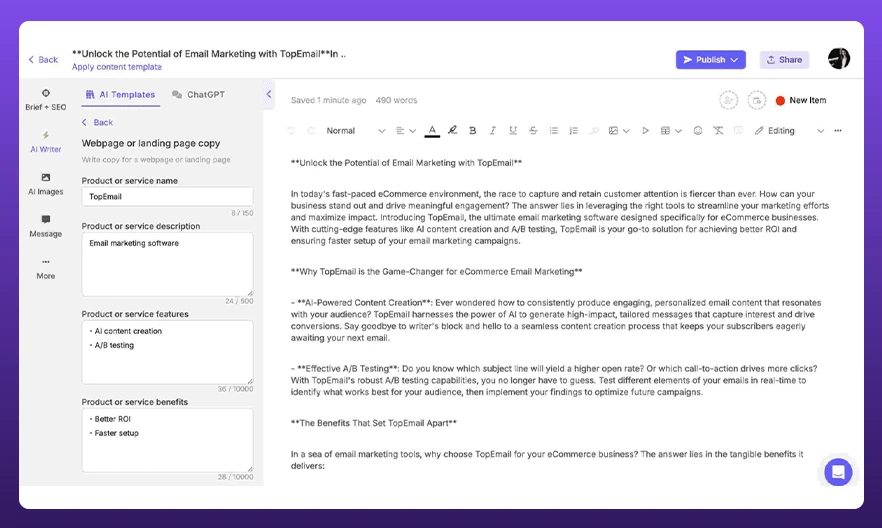
Language Models for Drafting: Tools like ChatGPT, Jasper, and Copy.ai generate drafts that writers can refine, saving valuable time on initial content creation.
Editing and Grammar Tools: AI platforms like Grammarly and ProWritingAid provide real-time edits and style suggestions, helping writers produce polished, error-free content.
Content Personalization Platforms: Tools like Persado and Phraseeanalyze audience behaviour, suggesting language and phrasing that resonates with different demographic groups.
These tools make it possible for copywriters to quickly produce high-quality content tailored to diverse audiences, allowing for rapid content iteration and adaptation based on real-time needs.
3. Boosting Efficiency with AI-Assisted Research
AI simplifies research, enabling copywriters to gather data and insights faster than ever before. By quickly sourcing relevant facts, statistics, and competitor information, AI empowers writers to back their content with credibility, enhancing the content’s authority and relevance.
Automated Research Insights: Tools like Crayon monitor competitor activity, audience sentiment, and industry trends, giving copywriters timely data needed to stay current and relevant.
Audience Insights: AI-powered analytics platforms, such as HubSpotand Sprinklr, analyze audience behaviour, preferences, and engagement patterns, helping writers craft messages that resonate deeply with target demographics.
Keyword Optimization: AI tools like Clearscopeand SurferSEO recommend keywords based on search intent and relevance, ensuring that copy is optimized for search engines and easily discoverable.
These AI-driven insights save hours of research time, allowing writers to concentrate on crafting high-quality, engaging messages that speak directly to their audience’s needs and interests.
4. Enhancing Personalization for Targeted Copy
One of AI’s most impactful contributions to copywriting is its ability to personalize content. Personalization goes beyond addressing the reader by name; it involves crafting messages tailored to individual preferences, buying patterns, and behaviours, which significantly boosts engagement and conversion rates.
Dynamic Content Generation: AI can create unique messages for different audience segments, making the content more relevant and impactful for each group.
Behavioural Insights: By analyzing user behaviour, such as click patterns, purchase history, and browsing habits, AI can predict what type of content will resonate most with specific audience segments.
Real-Time Adaptation: AI can adjust messaging based on live feedback and engagement metrics, allowing for on-the-spot optimization that traditional methods cannot match.
This level of personalization is proven to enhance engagement, conversion rates, and customer satisfaction, all while allowing copywriters to produce impactful, data-driven content on a large scale.
5. Streamlining A/B Testing and Optimization
AI is revolutionizing A/B testing by making it faster, more efficient, and data-driven. With machine learning algorithms, AI can quickly identify which copy elements resonate most with audiences, from headlines and calls to action to overall tone and structure.
Automated Testing: AI can run simultaneous tests on multiple versions of copy, gathering performance data in real time to determine which performs best.
Instant Analytics: AI tools provide immediate feedback on which copy versions drive engagement, allowing writers to make quick, data-driven adjustments to optimize performance.
Dynamic Adjustments: Based on real-time data, AI tools can automatically tweak underperforming copy, enhancing responsiveness and relevance throughout the testing process.
This automated approach not only improves the effectiveness of A/B testing but also maximizes engagement by delivering optimized content faster and more efficiently.
6. Creating Engaging Headlines and CTAs
Headlines and CTAs are critical for capturing attention, and AI’s predictive capabilities help craft these elements to be as engaging and action-oriented as possible. By analyzing past data, AI can recommend phrasing and structure that are more likely to encourage clicks and conversions.
Headline Optimization: Tools like CoSchedule’sHeadline Analyzer recommend high-impact words and phrasing to create headlines that maximize engagement.
Predictive CTA Suggestions: AI can suggest CTAs based on historical campaign data, allowing writers to craft language that effectively encourages user action.
Emotional Analysis: AI assesses emotional cues in language, helping writers develop CTAs that resonate emotionally, and fostering deeper connections with the audience.
AI-driven headline and CTA optimization ensure that every word choice is intentional, targeted, and designed for impact, helping maximize conversion potential.
SEO is a critical element of online content, and AI simplifies the optimization process. AI-powered SEO tools analyze search trends, recommend high-value keywords, improve readability, and ensure that copy is optimized for visibility in search engines.
Keyword Recommendations: AI platforms like MarketMuse and Clearscope suggest relevant keywords and related terms, based on current search trends, that align with user intent and boost discoverability.
Content Structure and Readability: AI tools analyze copy for readability, making structure and flow suggestions that improve user engagement, which positively impacts SEO performance.
Monitoring and Updating: AI tracks SEO performance over time, offering recommendations to keep content relevant and competitive in an ever-evolving search landscape.
These tools streamline the SEO process, making content easier to discover, more engaging, and more likely to rank well in search results.
8. Ethical Considerations in AI Copywriting
As AI’s role in copywriting grows, ethical considerations become increasingly important. Writers and companies must ensure that AI-generated content remains authentic, respects user privacy, and aligns with ethical standards.
Avoiding Over-Automation: AI should assist, not replace, writers. Maintaining a human touch in copywriting preserves authenticity, emotion, and brand voice.
Ensuring Data Privacy: Personalization requires user data, so it’s essential to respect privacy by using compliant and ethical data practices.
Balancing AI and Creativity: While AI enhances efficiency, creativity should still be central to copywriting. Human oversight is crucial to crafting meaningful, engaging messages.
Maintaining these ethical standards is vital for building trust and credibility, ensuring that AI remains a valuable tool without compromising authenticity or user trust.
Conclusion: Embrace AI as a Copywriting Partner
AI is transforming the copywriting landscape by helping writers produce compelling, tailored content faster than ever. From generating initial drafts to optimizing for SEO and personalization, AI tools provide invaluable support, allowing copywriters to focus on creativity and strategic messaging. By embracing AI as a partner rather than a replacement, businesses and writers can produce high-quality, efficient, and impactful messages that resonate in 2026 and beyond.
In a fast-paced digital world, leveraging AI’s capabilities is the key to crafting copy that not only meets audience needs but also stands out in an increasingly competitive landscape. Embrace AI as a copywriting ally to stay ahead, create meaningful connections, and drive success in the ever-evolving digital space.
The New Facebook Ads Playbook: Strategies to Maximize Reach & Results in 2026
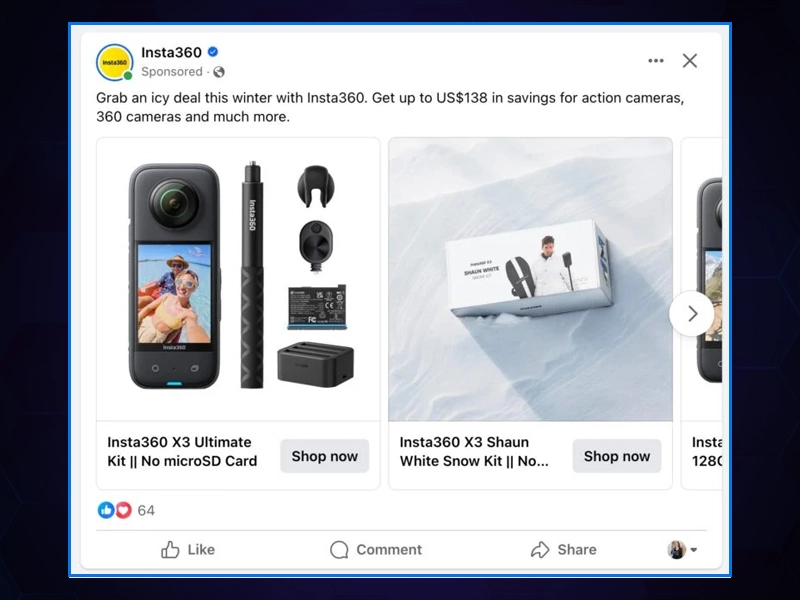
In 2026, Facebook advertising has evolved into a more sophisticated, data-driven platform that offers marketers unparalleled reach and engagement. However, with constant updates to algorithms, new ad formats, and stricter data privacy regulations, maximizing ad performance on Facebook requires a strategic, targeted approach. The Facebook Ads landscape is more competitive than ever, so if you’re looking to drive impactful results, it’s essential to adapt to these changes and stay ahead.
This playbook provides the latest strategies for maximizing reach and conversions with Facebook Ads in 2026. We’ll cover insights on audience targeting, ad creative, campaign structure, and optimization tips to help you make the most of your budget and see measurable returns.
Leveraging Audience Insights for Precision Targeting
A successful Facebook Ads campaign starts with understanding and targeting the right audience. In 2026, Facebook’s targeting tools will be more advanced, allowing marketers to go beyond basic demographic data. Here’s how to take advantage of these tools:
Custom Audiences: Build Custom Audiences from your existing customer data, website visitors, or social media engagers. These audiences allow you to retarget people already familiar with your brand, increasing the chances of conversion.
Lookalike Audiences: Expand your reach by targeting Lookalike Audiences based on your Custom Audiences. This strategy lets you tap into potential customers who share characteristics with your current audience, broadening your exposure to high-value prospects.
Interest & Behavior Targeting: Narrow down your audience with Facebook’s interest and behaviour targeting, reaching users who are more likely to engage with your ads based on their online activity and lifestyle.
Geo-Targeting: If location is relevant, use geo-targeting to reach users in specific areas or regions, making your ads highly relevant for local audiences.
By leveraging these targeting features, you’ll improve ad relevance and reach users who are more likely to take action.
Dynamic Creative Optimization for Personalized Facebook Ads
Dynamic Creative Optimization (DCO) is a powerful tool that automates ad personalization by testing various combinations of your ad components. With DCO, you can deliver ads tailored to individual users, increasing engagement and effectiveness. To maximize your DCO strategy:
Add Multiple Variants: Include several variations of each component, like images, videos, headlines, and CTAs, allowing Facebook to test and optimize for the best-performing combinations.
Analyze Top-Performing Elements: Use DCO’s insights to see which elements perform best, helping you make data-driven decisions about future campaigns.
Use in High-Intent Campaigns: Dynamic Creative works particularly well in campaigns aimed at warm audiences, where personalized messaging can push users toward conversion.
Personalized ads through DCO allow you to meet each user’s needs and preferences, enhancing their interaction with your brand.
The Power of Video Content for Engagement
Video content remains one of the most engaging ad formats on Facebook. It captures attention quickly and communicates more in a short time, ideal for a platform where users scroll rapidly. In 2026, consider these video strategies:
Short-Form Videos (Under 15 Seconds): Keep videos short and to the point to capture attention and deliver a concise message without losing viewer interest.
Storytelling Approach: Go beyond product promotion; tell a story that resonates with your audience emotionally. This could be a customer success story, a product journey, or a lifestyle narrative.
Optimize for Sound-Off Viewing: Since many users watch videos without sound, add captions and use clear visuals to convey your message effectively.
Video content increases brand recall, keeps users engaged longer, and enhances overall ad performance on Facebook.
Interactive Facebook Ads Formats for Enhanced Engagement
Interactive ad formats offer a unique way to engage users and create memorable ad experiences. In 2026, Facebook will offer various interactive formats that help your brand stand out. Consider these options:
Poll Ads: Encourage interaction by asking users a question or letting them vote on a topic. Poll ads drive engagement and provide valuable insights into customer preferences.
Playable Ads: Ideal for app promotion, playable ads let users experience a demo before downloading. This interactive format allows users to engage with your product, resulting in high-quality installs and leads.
Augmented Reality (AR) Ads: Let users virtually try on products, like sunglasses or makeup, using their device’s camera. AR ads are immersive and create a unique, memorable experience, especially for product-based brands.
Instant Experiences (Canvas Ads): Instant Experiences are full-screen, mobile-optimized ads that load instantly and allow users to interact with your brand through photos, videos, and carousels.
Interactive formats not only captivate users but also encourage deeper engagement, helping your brand make a lasting impression.
Mastering Retargeting for Maximum Conversions
Retargeting helps you reach users who have already interacted with your brand, reminding them to complete their journey with you. In 2026, more advanced retargeting strategies can re-engage potential customers effectively:
Website Custom Audiences: Retarget users who visited specific product pages or added items to their cart but didn’t complete the purchase, nudging them back toward conversion.
Engagement Retargeting: Target users who have engaged with your content on Facebook or Instagram, such as likes, shares, or comments. This approach re-engages warm leads who have shown interest in your brand.
Video Retargeting: Retarget users who watched a certain percentage of your videos. This is particularly effective for re-engaging users who are interested but haven’t taken action.
Sequential Retargeting: Create a sequence of retargeting ads that guide users through the customer journey. For instance, introduce your brand in the first ad, share product benefits in the second, and offer a special deal in the final ad.
By using these retargeting strategies, you can encourage users to return and complete their purchases, increasing your overall conversion rate.
Conversion-Focused Facebook Ads Targeting and Optimization
A successful Facebook Ads strategy in 2026 means going beyond reach and engagement; it requires focusing on driving conversions. Here’s how to maximize your conversion rates:
Leverage Facebook Pixel: Install Facebook Pixel on your website to track visitor actions and optimize for conversions. Pixel data helps you retarget users and tailor ads to those who are most likely to convert.
Set Up Custom Conversions: Define custom conversion events (like adding items to a cart or completing a form) to track high-value actions and optimize campaigns toward these specific goals.
Utilize Lookback Windows: Customize lookback windows based on your typical sales cycle. A longer lookback window works well for higher-consideration purchases, while a shorter one is ideal for quicker decisions.
Optimize Ad Frequency: High ad frequency can lead to ad fatigue. Monitor and adjust frequency to keep your audience engaged without overwhelming them.
Optimizing for conversions helps turn ad views into actionable outcomes, ensuring your ads drive the results that matter most to your business.
Data-driven optimization is critical in managing effective Facebook Ads campaigns. Regular monitoring ensures your ads align with your goals and adapt as needed. Key metrics to track include:
Click-Through Rate (CTR): A high CTR indicates effective messaging and targeting. Review CTR regularly to assess ad relevance and make adjustments.
Conversion Rate: Track the conversion rate to measure how well your ads drive actions like purchases or sign-ups. High conversion rates show alignment between your ads and audience intent.
Ad Relevance Score: Facebook’s ad relevance score provides insight into how your ads resonate with your target audience. Higher scores mean your ad is engaging and meeting audience expectations.
Cost per Result: Monitor your cost per result to stay within budget while achieving your campaign objectives. If costs rise without improved performance, consider adjusting targeting or ad creatives.
Using Facebook’s Ads Manager and third-party analytics tools, analyze these metrics to continually optimize your campaigns, ensuring you’re making the most of your ad spend.
Conclusion: Elevate Your Facebook Ads in 2026
Facebook Ads in 2026 offer an array of tools and options for creating effective, engaging campaigns. By understanding your audience, experimenting with ad formats, and optimizing for conversions, you can maximize reach, drive engagement, and generate meaningful results. Each strategy in this playbook empowers you to connect with users in ways that resonate, encouraging them to take action and grow with your brand.
With a strong foundation in targeting, creative content, and continuous optimization, your Facebook Ads can deliver the results you need in 2026 and beyond. Dive into these strategies, test what works best for your brand, and watch your campaign performance reach new heights.
Digital Marketing Strategy in 2026: Building Sustainable Funnels that Convert Long-Term
In 2026, the digital marketing landscape is more competitive than ever, demanding strategies that do more than deliver quick wins. Successful businesses are shifting focus to sustainable marketing funnels—structured pathways designed to guide potential customers from awareness to conversion while building lasting relationships. Creating these funnels requires understanding customer needs, leveraging data, and prioritizing consistent engagement. Below, we break down the actionable steps to build sustainable funnels that deliver long-term results in an ever-evolving market.
Digital Marketing Strategy 1: Understand the New Buyer’s Journey
The buyer’s journey is no longer linear. In 2026, customers will have access to more information, interact with multiple touchpoints, and demand greater transparency and personalization. A sustainable funnel must align with this modern, non-linear path.
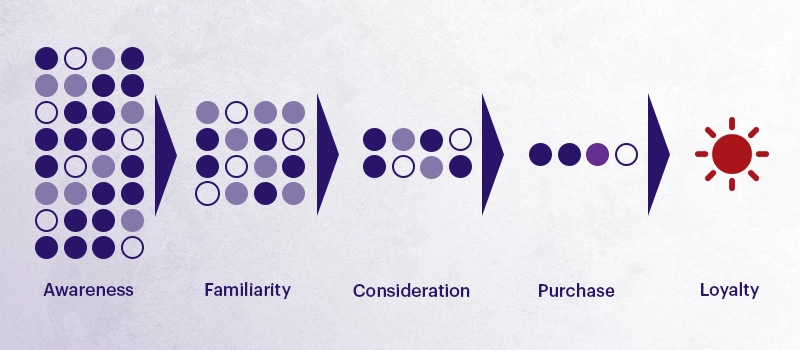
Awareness Stage: Create high-quality content that educates and informs your audience. Use blog posts, infographics, videos, and social media to address common questions and pain points.
Consideration Stage: Showcase your expertise with detailed guides, case studies, and webinars. Offer free trials or demos to help potential customers evaluate your product or service.
Decision Stage: Use trust signals like reviews, testimonials, and guarantees to encourage prospects to take the final step. Optimize landing pages and CTAs to ensure an easy, friction-free purchase process.
Post-Purchase Stage: Reinforce customer decisions with thank-you emails, product guides, and loyalty incentives to build long-term trust.
Tip: Leverage customer journey mapping tools like Lucidchart or HubSpot to visualize and refine your funnel touchpoints.
Digital Marketing Strategy 2:Prioritize Content Marketing for Sustainable Funnels
Content is the foundation of a sustainable funnel, acting as a bridge between your brand and audience. In 2026, content marketing requires a strategic approach to remain relevant and engaging.
Build Content Libraries: Create a comprehensive library of evergreen resources, such as how-to guides, whitepapers, and templates, that continually drive traffic.
Use AI-Driven Content Insights: Tools like BuzzSumo and Clearscope help identify trending topics and gaps in your content strategy, ensuring you stay ahead of competitors.
Repurpose Content Across Channels: Turn blog posts into videos, social media snippets, or email campaigns to maximize reach and engagement.
Personalize with Behavioral Data: Use first-party data to tailor content experiences based on user behavior and journey stage, boosting relevance and conversion.
Integrate Interactive Formats: In 2026, interactive content like quizzes, polls, and calculators not only improves engagement but also captures valuable insights for lead nurturing
Tip: Refresh your content regularly to reflect updated industry trends and maintain search engine relevance.
Digital Marketing Strategy 3: Leverage Multi-Channel Marketing
A funnel that relies on a single channel risks losing relevance as consumer preferences evolve. Multi-channel marketing ensures a consistent flow of leads and engagement by meeting audiences where they are.
Search Engines: Combine organic SEO and PPC campaigns to capture intent-driven traffic.
Social Media Platforms: Tailor content to the strengths of each platform—short videos for TikTok, professional updates for LinkedIn, and community engagement on Instagram.
Email Marketing: Send targeted messages based on audience behavior to nurture leads effectively.
Emerging Channels: Experiment with platforms like podcasts or live-streaming for deeper audience connections.
Offline and Online Integration: Use QR codes or in-store promotions to bridge digital and physical touchpoints, ensuring a cohesive experience.
Tip: Use tools like Hootsuite or Sprout Social to manage and track multi-channel campaigns seamlessly.
Digital Marketing Strategy 4: Focus on First-Party Data for Funnel Optimization
As third-party data fades into the background, first-party data is emerging as a cornerstone of digital marketing. Collecting and leveraging this data ensures your funnels remain relevant, personalized, and compliant with privacy regulations.
Interactive Lead Magnets: Offer calculators, quizzes, or gated content to collect valuable user data while providing immediate value.
Email Segmentation and Personalization: Segment your email list based on user preferences, behavior, or demographics, and send personalized messages that resonate.
Behavioral Targeting: Use website tracking tools like Hotjar or Crazy Egg to analyze user behavior and optimize funnel touchpoints.
Utilize Customer Data Platforms (CDPs): Adopt platforms like Segment and Tealium to unify data across multiple touchpoints, enabling more accurate customer segmentation and targeted messaging.
Improve Customer Retention: First-party data facilitates proactive engagement and loyalty programs, effectively improving customer lifetime value (CLV) and reducing churn.
Tip: Build trust with your audience by being transparent about data usage and offering opt-in choices.
Digital Marketing Strategy 5: Create Trust with Consistent Messaging and Transparency
Trust is the currency of long-term conversions. Every stage of your funnel must build confidence in your brand through consistent messaging, authenticity, and clarity.
Establish Clear Brand Communication: Maintain consistency across all platforms—websites, social media, and emails—to build recognition and reliability among audiences.
Prioritize Authenticity and Transparency: Share openly about your products, services, and company practices, including how you handle user data, to foster customer trust.
Respond Proactively to Feedback: Actively address customer concerns or reviews in a transparent, empathetic manner to strengthen trust and demonstrate your brand’s integrity.
Showcase Social Proof and Testimonials: Regularly feature genuine customer reviews, case studies, and endorsements across your marketing channels to reinforce trustworthiness.
Communicate Clearly on Privacy: Explicitly outline your privacy policies and data handling practices, reassuring customers that their information is secure and respected, aligning with evolving data regulations in 2026.
Tip: Foster authenticity by maintaining a consistent brand tone and responding to customer feedback promptly.
Digital Marketing Strategy 6: Use Automation for Scalability
5 stages of the automated sales funnel
Automation is essential for managing funnels efficiently, especially as your business scales. With the right tools, you can create personalized, timely, and impactful experiences without manual effort.
Automated Email Sequences: Nurture leads through automated workflows that guide them through the funnel.
Chatbots for Instant Support: Use AI chatbots to answer FAQs, qualify leads, and reduce response time.
Retargeting Campaigns: Automatically re-engage users who abandon carts or drop off during the funnel journey.
CRM Integration: Connect your CRM to track customer interactions and optimize outreach.
AI Recommendations: Use predictive analytics to suggest next steps, like upsells or cross-sells, based on user behavior.
Tip: Balance automation with human interaction to maintain personalization and authenticity.
Digital Marketing Strategy 7: Monitor and Optimize Your Funnels Continuously
Sustainable funnels require ongoing monitoring and refinement. Regular analysis ensures your funnel evolves with audience behavior and industry trends.
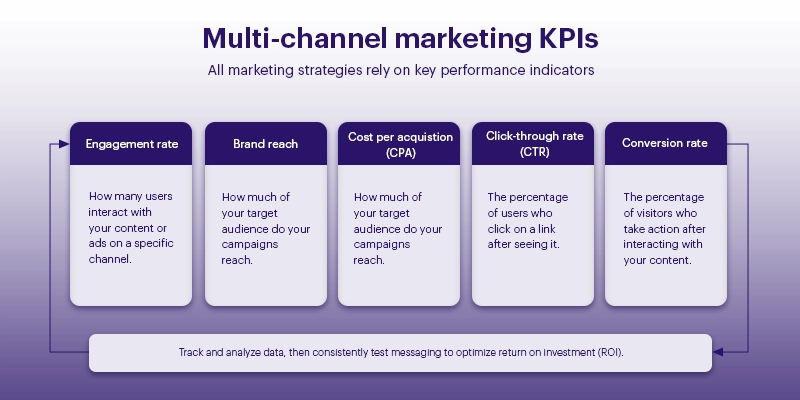
Track Key Metrics: Focus on conversion rates, customer acquisition costs, and lead-to-customer ratios to gauge funnel performance.
Run Split Tests: Experiment with different headlines, visuals, and CTAs to identify elements that drive the best results.
Gather Feedback: Use surveys, focus groups, and customer interviews to understand pain points and refine your funnel experience.
Regular A/B Testing: Continuously experiment with elements like landing pages, CTAs, and ad creative to improve engagement and conversion rates.
Multi-Touch Attribution: Implement attribution models to pinpoint precisely which channels and touchpoints deliver maximum ROI.
Tip: Use analytics platforms like Google Analytics 4 and HubSpot to gain actionable insights into your funnel’s performance.
Digital Marketing Strategy 8: Emphasize Long-Term Customer Relationships
A funnel’s success isn’t just measured by the number of conversions but by the relationships it fosters. Focus on creating loyal customers who advocate for your brand.
Onboarding Campaigns: Guide new customers with emails, tutorials, or consultations to ensure they maximize the value of your product.
Exclusive Rewards Programs: Offer discounts, early access, or loyalty perks to encourage repeat purchases.
Engage Through Communities: Create forums, groups, or live events where customers can connect with your brand and each other.
Encourage Referrals: Incentivize satisfied customers to refer friends, creating a virtuous cycle of trust and growth.
Tip: Build a community around your brand through forums, social media groups, or events to deepen customer engagement.
Conclusion: Build Funnels for Long-Term Success
In 2026, building sustainable funnels that convert long-term requires more than clever tactics—it demands a strategic approach centered on trust, personalization, and adaptability. By understanding the buyer’s journey, leveraging first-party data, and creating seamless, multi-channel experiences, businesses can ensure consistent growth and customer loyalty.
Remember, the goal of a sustainable funnel is not just to generate leads but to build meaningful relationships with your audience. As the digital landscape continues to evolve, these strategies will help you stay ahead of the curve, ensuring your funnels deliver value and conversions for years to come.
The Ultimate Guide to High-Impact Email Marketing Campaigns in 2026
In the digital age, email marketing remains one of the most effective tools for connecting with audiences and driving conversions. It combines cost-effectiveness with unparalleled reach, making it a cornerstone of any digital marketing strategy. However, as consumer expectations evolve, so must your email marketing approach. In 2026, high-impact campaigns will be defined by personalization, engagement, and innovative strategies that cater to individual preferences and behaviors. Whether you’re a small business or a global brand, this guide will help you craft email marketing campaigns that deliver exceptional results and foster meaningful relationships.
1. Understand the Foundations of Email Marketing Success
Before diving into advanced strategies, it’s essential to master the fundamentals. A strong foundation ensures that your campaigns are set up for success.
Know Your Audience: Segment your email list into specific groups based on demographics, behaviors, or interests. This allows you to deliver content that resonates with each segment, increasing engagement and relevance. Segmentation ensures your campaigns feel personal and not generic.
Optimize for Mobile: With over 60% of emails opened on mobile devices, having a responsive design isn’t optional—it’s critical. Use single-column layouts, larger fonts, and easy-to-tap buttons to enhance the mobile experience. Mobile optimization can significantly reduce bounce rates and improve click-through rates.
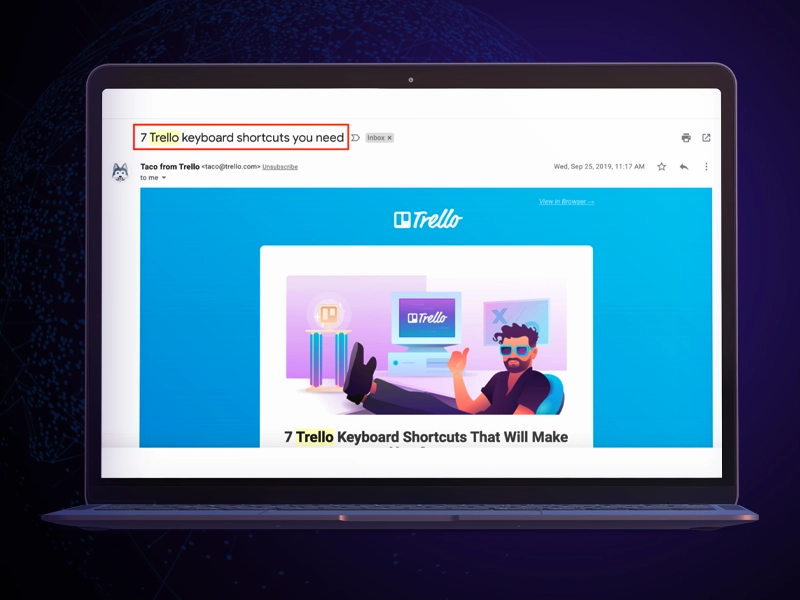
Craft Compelling Subject Lines: Your subject line is the gateway to your email. It should pique curiosity, offer value, or evoke emotion while staying concise. For example, “Exclusive Offer Just for You!” is more engaging than “Our Latest Update.” Aim for a maximum of 60 characters to ensure readability on all devices.
Timing Matters: Experiment with different send times to find when your audience is most likely to open emails. Morning emails might work better for professionals, while evening emails could resonate with casual consumers. Leverage analytics tools to identify optimal times for your unique audience.
Tip: Use A/B testing to refine each element of your emails, from subject lines to send times, to maximize effectiveness.
2. Email MarketingPersonalization: The Key to Higher Engagement
In a crowded inbox, personalization is what sets your emails apart. By making your communications feel tailored and relevant, you can significantly improve engagement rates.
Dynamic Content: Incorporate elements that change based on recipient data, such as product recommendations or location-based offers. For instance, an e-commerce email can display winter coats for users in colder regions while showcasing summer wear for warmer climates. Dynamic content not only improves engagement but also drives conversions.
Behavioral Triggers: Automate emails based on user actions, such as sending a follow-up when someone clicks on a product but doesn’t make a purchase. Behavioral triggers keep your communication timely, increasing the likelihood of conversions.
Use Recipient Names: Personalizing emails with the recipient’s name in the subject line or body creates a sense of connection. “Hi Sarah, Here’s Your Exclusive Deal” feels more personal than “Exclusive Deal Inside.” Adding names can boost open rates significantly.
Preference Centers: Allow subscribers to choose the type and frequency of emails they want to receive. This not only reduces unsubscribes but also improves the overall user experience by giving recipients control.
Geo-Targeting: Tailor emails based on the recipient’s location, promoting local events or region-specific offers to make your campaigns more relevant. For example, promote local store openings or area-specific discounts for maximum impact.
Tip: Tools like HubSpotand Mailchimpcan help you implement personalization at scale, ensuring that every email feels uniquely crafted.
3. Master the Art of Crafting Engaging Email Content
Engaging content is the cornerstone of successful email marketing. Your emails should deliver value, entertain, and guide readers toward taking action.
Provide Value First: Focus on solving your audience’s problems or offering exclusive insights. For example, instead of a generic promotional email, send a guide titled “10 Tips to Save Money on Your Next Purchase.” Value-first content builds trust and keeps readers coming back.
Include Strong CTAs: Every email should have a clear goal. Use call-to-action buttons with action-oriented language like “Get Started,” “Shop Now,” or “Claim Your Discount.” Strong CTAs provide direction and encourage immediate action.
Keep It Scannable: Use short paragraphs, bullet points, and bold headers to make your email easy to read. Most recipients skim emails, so structure your content to highlight key points and benefits.
Visual Elements: High-quality visuals like images, GIFs, and infographics make your emails visually appealing and help convey your message quickly. Visual elements should complement the content rather than distract from it.
Interactive Features: Incorporate polls, quizzes, or clickable buttons to encourage user interaction. Interactive content not only engages readers but also provides valuable data for future campaigns.
Storytelling: Share relatable stories or customer testimonials that emotionally connect with your audience. For example, highlight how your product helped a customer overcome a challenge or achieve a goal.
Tip: Ensure your visuals are optimized for fast loading times and always include alt text for accessibility.
4. Build and Maintain a High-Quality Email List
A high-performing email campaign starts with a healthy email list. Regularly refining your list ensures you’re reaching the right audience.
Offer Incentives for Sign-Ups: Lead magnets like discounts, free guides, or exclusive access can encourage website visitors to join your email list. Incentives make signing up a no-brainer for potential subscribers.
Clean Your List Regularly: Remove inactive subscribers to maintain high deliverability rates and avoid being flagged as spam. Keeping your list updated also improves engagement metrics.
Double Opt-In: Require subscribers to confirm their email address to ensure a high-quality list of engaged users. Double opt-in minimizes spam complaints and ensures genuine interest.
Engage Dormant Subscribers: Send re-engagement campaigns to win back inactive subscribers. Use subject lines like “We Miss You!” or offer exclusive deals to reignite interest. Re-engagement campaigns can help revive a significant portion of inactive users.
Tip: Focus on quality over quantity. A smaller, engaged list is far more effective than a large, inactive one.
5. Leverage Email MarketingAutomation for Scalability and Efficiency
Automation streamlines your efforts, making it easier to manage campaigns at scale while maintaining a personalized touch.
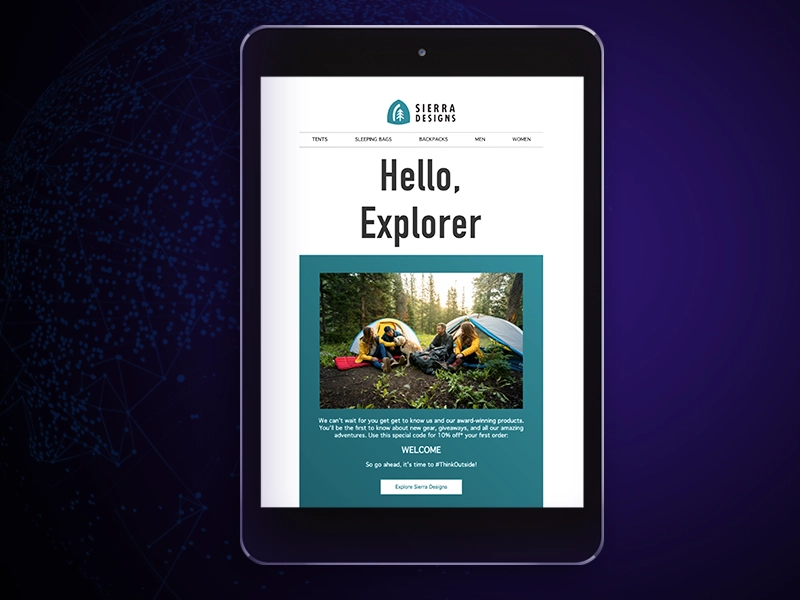
Welcome Sequences: Automate a series of welcome emails to introduce your brand and set the tone for future communications.
Lead Nurturing: Use drip campaigns to guide potential customers through the buyer’s journey with tailored content.
Abandoned Cart Emails: Remind users of products they left behind, offering discounts or incentives to complete their purchase.
Birthday or Anniversary Emails: Celebrate personal milestones with special messages or discounts to strengthen customer relationships.
Behavioural Triggers: Automate follow-ups based on user actions, like downloading a resource or clicking a product link.
Tip: Platforms like Klaviyoor ActiveCampaign can help you implement advanced automation with minimal effort.
6. Analyze, Optimize, and Repeat
Continuous improvement is the hallmark of a successful email marketing strategy. Regular analysis helps you identify strengths and areas for improvement.
Track Key Metrics: Focus on open rates, click-through rates, conversion rates, and unsubscribe rates to measure performance.
A/B Testing: Experiment with subject lines, CTAs, and layouts to determine what resonates most with your audience.
Use Heatmaps: Analyze where users click within your email to refine content placement and design.
Survey Your Audience: Ask subscribers for feedback on what they like or want to see in your emails.
Adjust Frequency: Monitor engagement and unsubscribe rates to find the optimal frequency for your campaigns.
Leverage Analytics Tools: Use platforms like Mailchimp, Campaign Monitor, or Google Analytics to gain insights into performance and make data-driven decisions.
Conclusion: Elevate Your Email Marketing in 2026
In 2026, email marketing is more than just a communication tool—it’s a way to build lasting relationships, deliver value, and drive consistent results. By mastering personalization, crafting engaging content, and leveraging automation, you can create campaigns that resonate deeply with your audience.
Remember, the key to success is adaptability: keep testing, refining, and evolving your strategy to meet changing consumer expectations. With these strategies, your email marketing efforts will not only stand out but deliver lasting impact, ensuring that your messages don’t just reach inboxes but inspire action.