

1. Overview
Competitive analysis is essential for effective Meta Ads strategy, but manually reviewing competitor ads in the Meta Ad Library is time-consuming, inconsistent, and easy to deprioritize. Strategists often intend to “check competitors weekly,” yet the task gets skipped once execution pressure increases.
To solve this, I built a Competitor Intelligence Bot—an automated system that tracks competitor ads weekly, captures creative and messaging changes, and delivers a structured intelligence report to strategists and PMs. The system eliminated manual ad library research while ensuring teams always had up-to-date competitive context before making creative or messaging decisions.
2. Background & Context
The agency managed paid social campaigns across:
◉ Lead generation funnels
◉ E-commerce brands
◉ Service-based offers with aggressive competition
◉ Markets where competitor messaging shifted frequently
Before automation, competitor research involved:
◉ Manually opening Meta Ad Library
◉ Searching each competitor brand
◉ Scrolling through active ads
◉ Taking screenshots or notes
◉ Relying on memory for “what changed”
This process was inconsistent and rarely documented properly.
3. Problem Statement
The existing competitor research process had clear weaknesses:
1. Manual checks were time-intensive and repetitive
2. Research was done inconsistently across teams
3. Creative and messaging shifts were noticed late
4. No historical tracking of competitor ads existed
5. Insights stayed in individual heads, not systems
Strategists needed reliable, recurring competitor intelligence without adding workload.
4. Tools & Automation Stack
Tech stack & tools used:
◉ Meta Ad Library (data source)
◉ Web scraping / structured extraction logic
◉ OpenAI API (creative and messaging analysis)
◉ Make.com / Zapier (workflow orchestration)
◉ Google Sheets (ad archive + change log)
◉ Slack / Email (weekly report delivery)
◉ ClickUp (optional: strategy tasks)
5. Automation Flow
The system followed this weekly pipeline:
1. Weekly scheduler triggers the bot
2. Competitor brand list is loaded
3. Meta Ad Library pages are scanned
4. Active ads are extracted and normalized
5. Changes vs previous week are detected
6. AI analyzes messaging and creative patterns
7. A structured intelligence report is generated
8. Report is delivered to strategists and PMs
This ensured competitor tracking happened every week without fail.
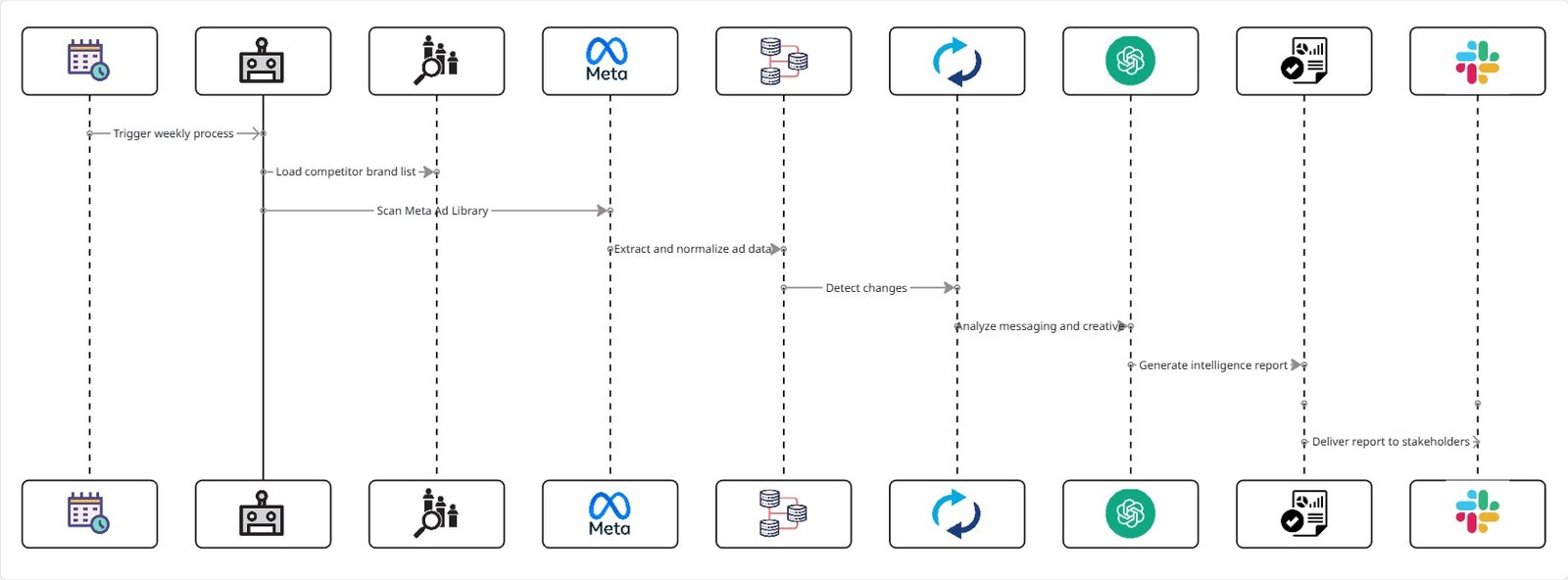
Fig. 1: Automated Competitor Intelligence Workflow Using Meta Ad Library
6. Implementation Details
6.1 Data Captured Per Competitor
For each competitor, the system collected:
◉ Ad copy (primary text, headline, CTA)
◉ Creative format (image, video, carousel)
◉ Offer framing (discount, consultation, urgency)
◉ Messaging angle (price, authority, pain-based, feature-based)
◉ Creative volume changes (new ads added / removed)
◉ Longevity signals (ads running multiple weeks)
This allowed both creative and strategic analysis.
6.2 Change Detection Logic
Each weekly run compared results against the previous snapshot:
◉ New ads launched → Highlighted
◉ Ads removed → Logged
◉ Messaging shifts → Flagged
◉ Offer changes → Flagged
◉ Creative format changes → Flagged
Only meaningful changes were surfaced to avoid noise.
6.3 AI Prompt (Competitor Insight Layer)
AI was used to translate raw ad data into strategic insights.
					You are a paid social strategist.

Given this week's competitor ad data and last week's snapshot:
- Identify new messaging angles
- Highlight notable creative changes
- Detect offer or positioning shifts
- Summarize what competitors are testing or scaling

Output:
1) Key changes this week
2) Messaging trends
3) Creative patterns
4) Strategic takeaways for our brand
Keep it concise and actionable.
This removed the need for manual interpretation.
6.4 Weekly Intelligence Report Format
Each report followed a fixed structure:
◉ Competitor summary table
◉ New ads launched (by competitor)
◉ Messaging and offer changes
◉ Creative format trends
◉ Strategic implications
◉ Suggested tests or adjustments
Strategists could consume the report in minutes.
7. Score Mapping / Classification Logic
Competitor activity was classified as:
| Status | Meaning | Action |
|---|---|---|
| Stable | Minimal change | Monitor |
| Testing | New creatives or angles | Review |
| Aggressive | Rapid expansion or new offers | Strategic response |
This helped prioritize attention across competitors.
8. ClickUp Automations
When notable competitor changes were detected:
					ClickUp task created automatically
Tagged as “Competitor Insight”
Linked to affected campaign or funnel
Suggested test added as checklist item
Assigned to strategist or PM
When notable competitor changes were detected:
9. Code-to-Business Breakdown
| System Component | Business Impact |
|---|---|
| Weekly scraping | Eliminates manual ad library research |
| Change detection logic | Focuses attention on what actually changed |
| AI insight generation | Converts data into strategy |
| Structured reporting | Improves team alignment |
| ClickUp integration | Turns intelligence into action |
10. Results & Performance Impact
1. Research Time Reduced
◉ Manual competitor checks removed
◉ Strategists saved hours every week
2. Faster Creative & Messaging Adjustments
◉ Teams reacted earlier to market shifts
◉ New angles identified proactively
3. Better Strategic Alignment
◉ PMs and strategists shared the same intelligence
◉ Fewer subjective “I think competitors are doing X” conversations
4. Scalable Competitive Awareness
◉ Tracking expanded to more competitors without added effort
11. Challenges & How They Were Solved
Challenge: Meta Ad Library layout changes
Solution: Flexible scraping selectors and fallback logic
Challenge: Too much raw data
Solution: Change-based filtering and AI summarization
Challenge: Insight overload
Solution: Limited report to strategic shifts only
12. Lessons for Project Managers
◉ Competitive research should be automated, not optional
◉ Historical tracking matters more than snapshots
◉ PMs benefit from structured intelligence, not raw ads
◉ Automation creates consistency across teams
◉ Strategy improves when insights arrive regularly
13. Conclusion
The Competitor Intelligence Bot transformed competitor research from a manual, inconsistent task into a reliable weekly system. By automatically tracking Meta Ad Library changes and delivering structured insights, the system reduced research time, improved strategic responsiveness, and ensured teams stayed aligned with the competitive landscape—without adding operational load.
Looking to Track Competitor Meta Ads Weekly and Get Actionable Insights Without Manual Research?