

1. Overview
Creative production is one of the most revision-heavy parts of agency operations. Designers, editors, and motion teams often receive incomplete or unclear briefs missing essential information such as brand guidelines, visual references, mandatory specs, formats, CTAs, or copy direction. These gaps lead to unnecessary back-and-forth revisions and significant delays in delivery.
To address this, I built an AI-powered creative brief validation system that reviews every brief upon submission, checks for completeness, identifies missing elements, and automatically requests updates from the requester. This ensured all briefs met a minimum standard before reaching the creative team, reducing revisions by 60% and improving creative turnaround time significantly.
2. Background & Context
3. Problem Statement
4. Tools & Automation Stack
5. Automation Flow
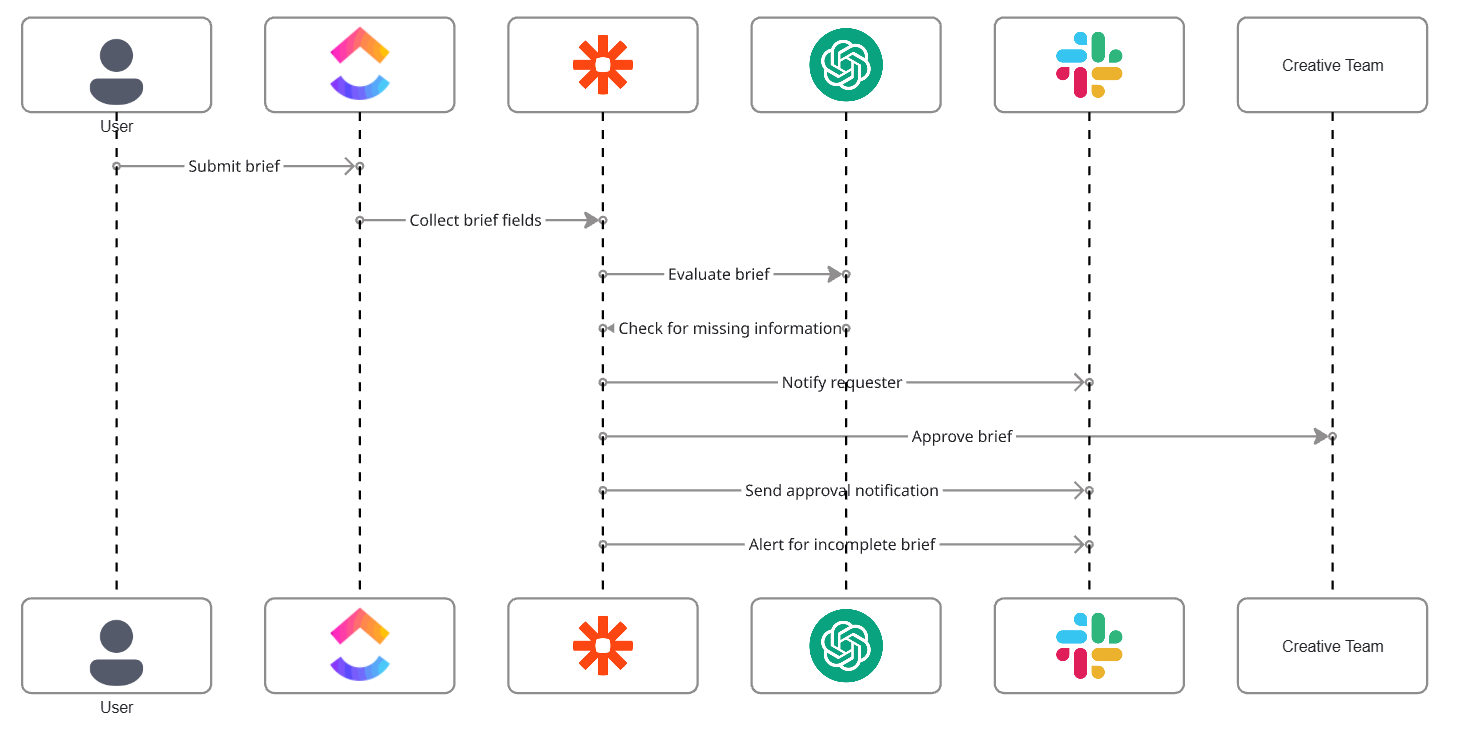
Fig. 1: AI-Assisted Creative Brief Validation and Approval Workflow
6. Implementation Details
6.1 AI Prompt (The Core Logic)
The following prompt validated creative briefs:
					Analyze the creative brief below and determine if it is complete.
Check for: brand guidelines, references, dimensions/specs, CTAs, messaging,
target audience, color/asset requirements, platform-specific rules, deadlines,
and any mandatory elements.

Brief: {{creative_brief}}

Output Requirements:
- List missing elements clearly
- State whether the brief is ‘Complete’ or ‘Incomplete’
- If incomplete, request exact details needed from the requester
The AI outputs a structured evaluation and completeness status.
6.2 Score Mapping (Interpretation Rules)
The AI evaluation classified briefs into:
| Category | Meaning | Behavior |
|---|---|---|
| Complete | All required fields present | Sent to creative team |
| Partially Complete | Some fields missing | Sent back for edits |
| Incomplete | Major details missing | Automatically requests info |
| Invalid | Ambiguous or unclear | Requires PM review |
6.3 ClickUp Automations
The following rules controlled brief routing:
					If AI result = Complete → Move to “Ready for Creative”
If AI result = Partially Complete → Notify requester for updates
If AI result = Incomplete → Reopen task with missing items list
If AI result = Invalid → Assign to PM for manual review
If requester updates brief → Trigger AI validation again
These rules ensured the pipeline stayed clean and only validated briefs moved forward.
6.4 Data Extracted for AI Validation
7. Code-to-Business Breakdown
| Logic / Code | Business Impact |
|---|---|
| AI completeness check | Removes repetitive PM pre-screening work |
| Missing-field detection | Prevents incomplete briefs reaching creatives |
| CTA/spec validation | Ensures platform compatibility |
| Reference verification | Reduces ambiguity and redesigns |
| Auto routing | Keeps pipeline clean and organized |
| Slack feedback loop | Speeds up requester corrections |
8. Real-World Brand Scenario: Deployment Inside OnDeemand
About OnDeemand (Operating Environment)
OnDeemand manages high-volume creative execution across multiple client accounts, with creatives directly tied to campaign performance and launch timelines. Creative teams support ongoing optimizations rather than one-off design work, making clarity at intake critical.
How Creative Briefs Were Handled Before the Workflow
Before automation:
◉ Brief quality varied significantly by requester
◉ PMs manually reviewed and corrected briefs
◉ Designers frequently requested clarification
◉ Revision cycles increased due to missing context
This approach became unsustainable as creative demand scaled.
Why the Need Became Critical
As creative volume increased:
◉ Incomplete briefs caused repeated revisions
◉ Campaign launches were delayed by clarification loops
◉ PM time shifted toward administrative validation
◉ Designers lost focus time resolving preventable issues
At this stage, brief quality became a bottleneck to delivery speed.
How the Workflow Was Implemented in Practice
The validation system was introduced as a background safeguard rather than a behavioral change.
Key implementation choices included:
◉ Enforcing quality through automation instead of training
◉ Providing precise, actionable feedback to requesters
◉ Keeping ClickUp as the single source of truth
◉ Re-validating briefs automatically after updates
Requesters continued submitting briefs normally while the system enforced standards invisibly.
How Execution Changed After Adoption
After stabilization:
◉ Designers received consistently complete briefs
◉ Revision cycles dropped significantly
◉ PMs spent less time screening requests
◉ Creative output aligned more closely with requirements
The system improved intake quality without slowing throughput.
9. Results Observed
Revision Reduction
◉ Revision cycles reduced by ~60%
◉ Fewer clarification rounds before final delivery
Time Saved
◉ PMs saved 6–7 hours per week previously spent validating briefs
◉ Designers saved 20–30 minutes per task that required no clarification
Workflow Quality
◉ All briefs met a minimum clarity standard
◉ Requesters developed better briefing habits through feedback
◉ Creative output became more consistent
Delivery Speed
◉ Assets delivered 25–35% faster on average
◉ Fewer delays caused by unclear requirements
10. Challenges & Adjustments
During live usage:
◉ Vague project descriptions → Required supporting references
◉ Industry misclassification → Expanded prompt context and examples
◉ Ignored correction requests → Added Slack reminders and PM escalation
These refinements improved compliance without adding friction.
11. Key Learnings
◉ Intake quality directly impacts downstream efficiency
◉ Automating validation prevents avoidable revisions
◉ AI excels at enforcing consistent standards
◉ Clear briefs enable faster, higher-quality creative output
◉ PMs regain time for strategic work instead of admin review
12. Conclusion
This case study demonstrates how an AI-assisted creative brief validation system can be implemented inside ClickUp and validated within a real marketing agency environment.
By enforcing brief completeness before production began, the system reduced revisions by 60%, improved designer efficiency, and eliminated delays caused by missing information—strengthening creative delivery without increasing operational complexity.
Ready to Eliminate Incomplete Briefs and Streamline Your Entire Creative Pipeline?