

1. Overview
Lead generation is only effective when followed by consistent and timely nurturing. In many sales environments, leads are collected successfully but not followed up systematically, resulting in missed opportunities and reduced conversion rates.
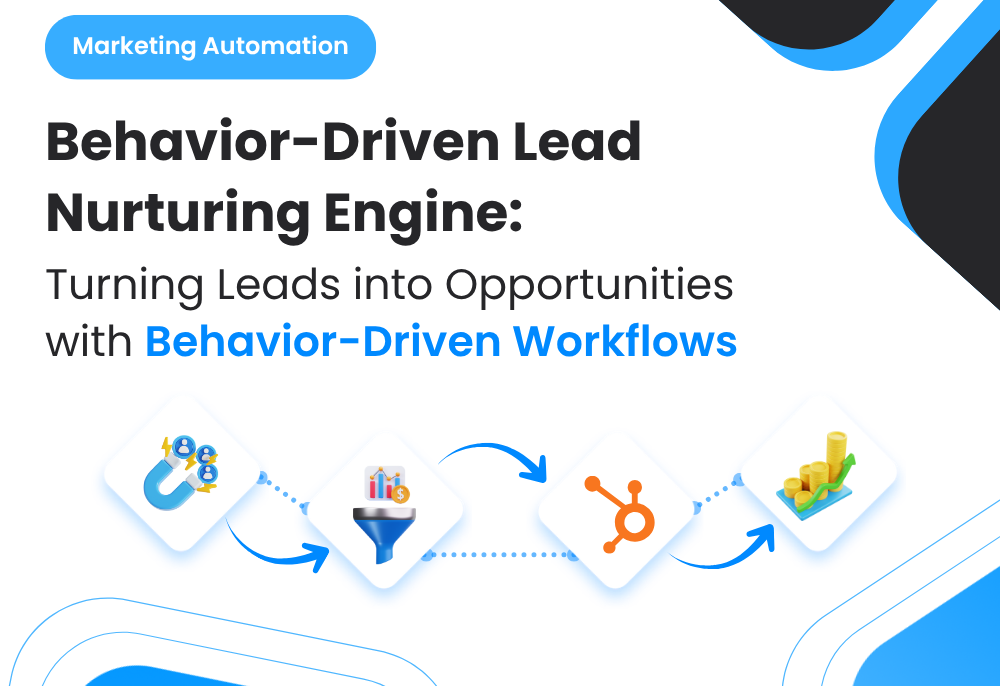
This case study documents the implementation of an Automated Lead Nurturing System inside HubSpot, where incoming leads are automatically segmented, enrolled into behavior-driven drip sequences, and guided through structured communication paths based on engagement and lifecycle stage.
The system replaces manual follow-ups with a fully automated, behavior-driven nurturing engine, ensuring that every lead receives timely, relevant communication without requiring constant sales team intervention.
2. Background & Context
Modern lead funnels operate across multiple channels, including:
◉ paid media campaigns
◉ website form submissions
◉ landing pages and gated content
◉ CRM integrations
◉ inbound inquiries
As lead volume increases, maintaining consistent follow-up becomes more challenging.
Sales teams typically struggle with:
◉ delayed responses
◉ inconsistent follow-up timing
◉ lack of personalization
◉ incomplete lead qualification
◉ manual outreach dependency
Without a structured nurturing system, many leads remain under-engaged or are lost entirely.
3. Problem Statement
Before automation, common challenges in lead nurturing included:
◉ leads not being contacted at the right time
◉ inconsistent follow-up across sales reps
◉ manual outreach consuming significant time
◉ no structured nurturing path based on lead behavior
◉ leads dropping off without engagement
◉ lack of visibility into lead progression
These issues reduced conversion efficiency and increased reliance on reactive sales activity.
4. Objective
The objective was to design a system-driven lead nurturing framework that could:
◉ automatically segment leads based on stage and behavior
◉ trigger personalized drip sequences
◉ adapt messaging based on engagement signals
◉ reduce manual follow-up workload
◉ improve lead-to-conversion rates
◉ create a scalable and consistent nurturing process
The system needed to operate entirely inside HubSpot while supporting real-time behavioral automation.
5. Tools & Automation Stack
The system was implemented using:
◉ HubSpot CRM – lead management and lifecycle tracking
◉ HubSpot Workflows – automation engine
◉ Email automation sequences – drip campaign delivery
◉ Lead scoring logic – engagement-based prioritization
◉ Behavior tracking (email, site, form activity) – trigger conditions
6. Automation Flow
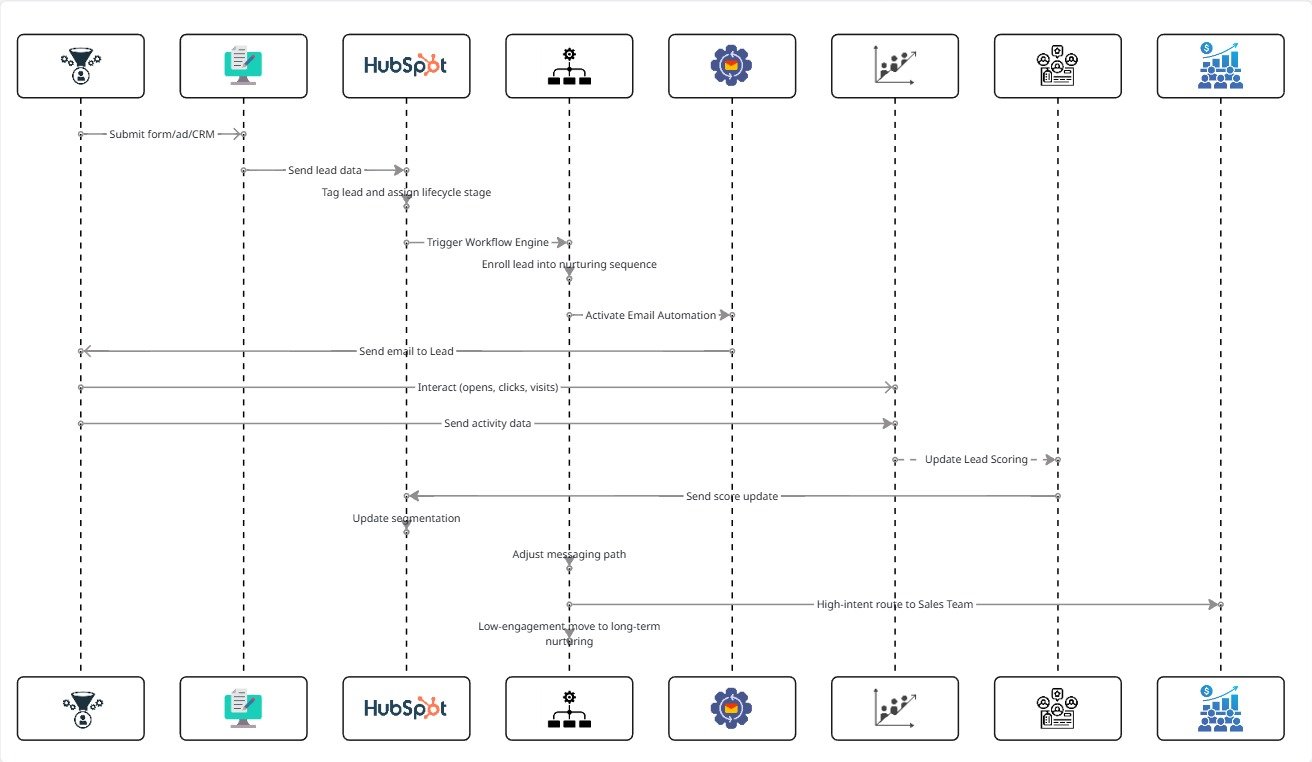
The system followed a structured nurturing pipeline:
◉ 1. Lead enters the system via form, ad, or CRM integration
◉ 2. Lead is tagged and assigned a lifecycle stage
◉ 3. Workflow enrolls the lead into a relevant nurturing sequence
◉ 4. Emails are sent based on predefined timing and conditions
◉ 5. Lead behavior (opens, clicks, visits) updates segmentation
◉ 6. Workflow adjusts messaging or sequence path dynamically
◉ 7. High-intent leads are flagged or routed to sales
◉ 8. Low-engagement leads are moved into long-term nurturing
This created a continuous, adaptive communication loop.
7. Nurturing Logic & Segmentation Structure
The system was governed by:
◉ lifecycle stage segmentation (new lead, engaged, qualified, inactive)
◉ behavioral triggers (email engagement, site visits, inactivity)
◉ conditional workflow branches
◉ lead scoring thresholds
◉ suppression logic to prevent over-communication
This ensured that every lead received communication aligned with their current level of intent.
8. Real-World Brand Scenario: Deployment Inside ENVEED
About ENVEED (Operating Environment)
ENVEED operates as a hemp-derived wellness brand offering products such as CBD and THC-infused gummies. The business relies heavily on digital channels for customer acquisition, education, and repeat purchases.Given the nature of the product category, customer journeys are often education-driven and trust-sensitive, requiring multiple touchpoints before conversion. Leads and subscribers typically move through stages of awareness, consideration, and repeat engagement rather than converting immediately.
This made structured lead nurturing a critical component of the overall marketing and sales process.
How Lead Nurturing Worked Before the System
Before the automated system was introduced:
◉ Leads were collected through website forms, campaigns, and product interest funnels
◉ Follow-up emails were sent inconsistently or manually
◉ Messaging was not always aligned with customer intent or stage
◉ High-intent leads were not clearly distinguished from low-engagement users
◉ Repeat engagement depended heavily on campaign pushes rather than structured automation
As a result, many leads remained under-nurtured, and conversion opportunities were delayed or missed.
Why the Need Became Critical
As ENVEED scaled acquisition and expanded its product offering:
◉ Lead volume increased across multiple entry points
◉ Educational follow-up became more important for conversion
◉ Manual outreach could not keep pace with incoming leads
◉ Lack of structured nurturing reduced conversion efficiency
◉ High-intent leads were not surfaced quickly for targeted engagement
At this stage, lead nurturing was no longer optional—it became essential for converting interest into revenue.
How the System Was Implemented in Practice
The automated lead nurturing system was introduced as a behavior-driven communication layer inside HubSpot.
Key implementation principles included:
◉ Segmenting leads based on lifecycle stage and engagement level
◉ Triggering drip sequences aligned with customer intent
◉ Using behavioral signals (email opens, clicks, site visits) to adjust messaging
◉ Assigning lead scores to identify high-intent prospects
◉ Routing qualified leads for priority follow-up when necessary
The system operated continuously, ensuring that every lead received structured, stage-appropriate communication without manual intervention.
How Execution Changed After Adoption
Once deployed for ENVEED:
◉ Every new lead entered a defined nurturing sequence immediately
◉ Messaging adapted based on engagement behavior and interest signals
◉ Educational content supported earlier-stage leads more effectively
◉ High-intent leads were identified and prioritized faster
◉ Manual follow-up dependency was significantly reduced
Lead management shifted from reactive outreach to a system-driven nurturing process.
9. Results Observed for ENVEED
Time Efficiency
◉ Significant reduction in manual follow-up workload
◉ Marketing and sales teams saved multiple hours weekly
Conversion Improvement
◉ Faster response and structured nurturing improved lead engagement
◉ Higher progression from lead to customer across funnels
Engagement Quality
◉ More relevant communication based on user behavior
◉ Improved interaction rates across email sequences
Scalability
◉ System handled increasing lead volume without added operational effort
◉ New leads automatically entered the nurturing lifecycle
10. Challenges & Adjustments
During live usage:
Early-stage leads required more education before conversion
◉ Expanded content depth within initial nurturing sequences
Lead scoring needed refinement for product-specific behavior
◉ Adjusted scoring logic based on engagement signals and product interest
Some leads disengaged during longer sequences
◉ Optimized timing, frequency, and content variation
11. Key Learnings
◉ Education-driven products require structured nurturing to convert effectively
◉ Behavioral segmentation significantly improves engagement quality
◉ Automated systems outperform manual follow-up at scale
◉ Lead scoring is critical for prioritizing high-intent prospects
◉ Consistent nurturing increases long-term conversion potential
12. Conclusion
This case study demonstrates how an Automated Lead Nurturing System inside HubSpot can be implemented for a hemp-based wellness brand like ENVEED to improve lead conversion and engagement at scale.
By combining lifecycle segmentation, behavior-driven communication, and automated workflows, the system transformed lead management into a structured, scalable process—reducing manual workload while improving conversion efficiency and customer engagement.
Looking to Build an Automated Lead Nurturing System in HubSpot That Converts Leads Consistently?