

1. Overview
High-spend customers contribute a disproportionate share of revenue, yet many brands treat them the same as regular customers. Without a structured loyalty system, these high-value users receive generic communication, leading to missed opportunities for retention and lifetime value growth.
To solve this, I built a VIP Loyalty Automation System that automatically identifies high-value customers based on spending behavior and engagement, assigns them to VIP segments, and triggers personalized perks and experiences.
The system ensures that valuable customers are consistently recognized, retained, and incentivized—without requiring manual tracking or intervention.
2. Background & Context
The system was designed for:
◉ E-commerce brands with repeat purchase behavior
◉ High-value customer segments
◉ Shopify + Klaviyo or CRM-based environments
◉ Brands focused on retention and LTV growth
Before automation, the brand faced:
◉ No clear VIP identification logic
◉ High-value customers treated like standard users
◉ Inconsistent loyalty rewards
◉ Missed opportunities for repeat purchases
◉ Lack of structured retention strategy
Customer value existed—but it was not operationalized.
3. Problem Statement
The system needed to solve:
◉ No consistent way to identify VIP customers
◉ Lack of structured rewards or recognition
◉ Missed retention opportunities
◉ Manual tracking of high-value users
◉ No automation tied to customer value
The goal was to convert high-value customers into a managed lifecycle segment.
4. Tools & Automation Stack
◉ Shopify (purchase and customer data)
◉ Klaviyo / CRM (segmentation and automation)
◉ RFM or spend-based scoring logic
◉ Email + SMS automation
◉ Tagging and property enrichment
◉ Conditional flow logic
This allowed dynamic identification and engagement.
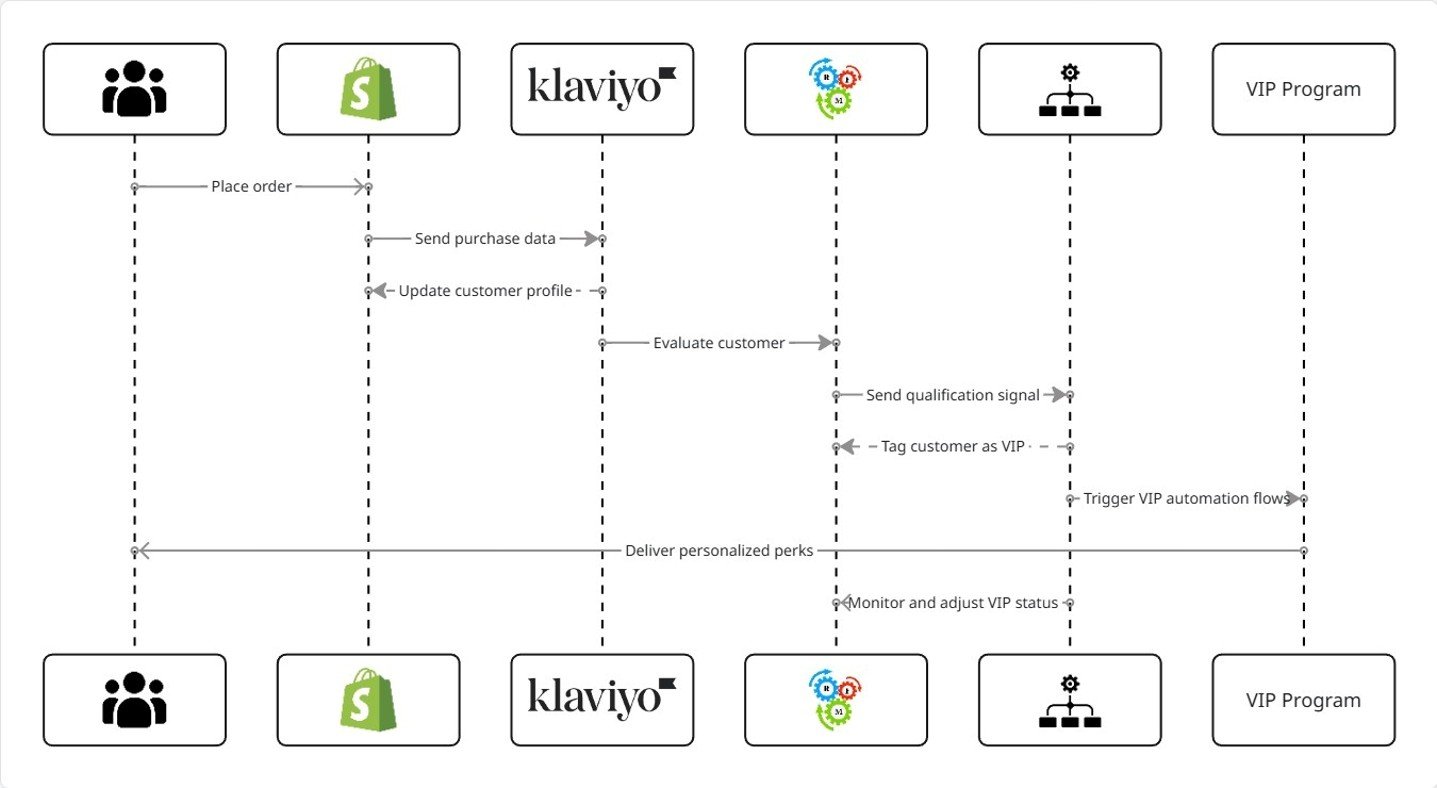
5. Automation Flow
The system followed this lifecycle:
1. Customer places orders over time
2. Purchase data updates customer profile
3. System evaluates customer against VIP criteria
4. If threshold met → customer tagged as VIP
5. Customer enters VIP automation flows
6. Personalized perks and communication triggered
7. VIP status maintained or adjusted dynamically
This created a real-time loyalty system.
6. Implementation Details
6.1 VIP Identification Logic
Customers were classified as VIP based on:
◉ Total spend threshold
◉ Purchase frequency
◉ Recency of purchases
◉ Engagement signals
Example:
◉ Total spend > defined value → VIP
◉ Multiple purchases within timeframe → VIP candidate
This ensured only high-value customers qualified.
6.2 VIP Segmentation Structure
VIP customers were grouped into tiers:
◉ Standard VIP
◉ High VIP
◉ Elite VIP
Each tier received differentiated treatment.
6.3 Trigger-Based Loyalty Flows
Once classified, customers entered flows such as:
VIP Welcome Flow
◉ Acknowledgment of VIP status
◉ Brand appreciation messaging
Exclusive Offer Flow
◉ Early access to products
◉ VIP-only discounts
Re-engagement Flow (VIP)
◉ Personalized win-back campaigns
◉ Higher-value incentives
6.4 Perk Distribution Logic
Perks included:
◉ Discount codes
◉ Early product access
◉ Priority communication
◉ Loyalty rewards
Rules ensured:
◉ Perks aligned with customer tier
◉ No over-distribution
◉ Controlled frequency
6.5 Communication Personalization
Messages were tailored using:
◉ Customer name and purchase history
◉ VIP status indicators
◉ Behavioral context
This reinforced exclusivity.
6.6 AI Prompt (Optional Personalization Layer)
					You are a retention strategist.

Generate a VIP customer message:
- Acknowledge their value
- Reinforce exclusivity
- Provide a clear benefit or reward

Tone: premium, appreciative, non-salesy.
7. Score Mapping / Classification Logic
| Segment | Behavior | Action |
|---|---|---|
| VIP Candidate | Near threshold | Monitor |
| VIP | Qualified high-value customer | Enter VIP flows |
| High VIP | Strong repeat + spend | Enhanced perks |
| Elite VIP | Top-tier customers | Priority treatment |
This ensured structured loyalty tiers.
8. CRM / Klaviyo Automations
The system included:
◉ Auto-tagging based on spend thresholds
◉ Dynamic segment updates
◉ Flow triggers on VIP entry
◉ Exit logic if behavior declines
◉ Suppression of standard campaigns for VIPs
This ensured VIPs received differentiated communication.
9. Code-to-Business Breakdown
| System Component | Business Impact |
|---|---|
| VIP identification logic | Recognizes high-value customers |
| Tier-based segmentation | Enables differentiated treatment |
| Trigger-based flows | Automates loyalty engagement |
| Personalized communication | Strengthens brand relationship |
| Perk distribution system | Encourages repeat purchases |
| Dynamic updates | Maintains segmentation accuracy |
10. Real-World Brand Scenario: Deployment for Project Nova (Pseudonym)
About Project Nova (Operating Environment)
Project Nova is a pseudonym used to protect the confidentiality of the original client. The strategies, workflows, and outcomes presented are based on real project experience, while identifying brand assets and confidential information have been modified or omitted.
This Brand operates as a fashion e-commerce brand with a strong emphasis on repeat purchases, customer retention, and long-term customer value. A significant portion of revenue is driven by returning customers, making high-value customer management a critical component of the overall growth strategy.
As the customer base expanded, identifying and nurturing top-spending customers became essential to maximizing lifetime value and maintaining brand loyalty.
How Loyalty Management Worked Before the System
Before the VIP automation system was implemented:
◉ High-value customers were not systematically identified
◉ All customers received similar communication regardless of value
◉ Loyalty rewards were applied inconsistently
◉ No structured VIP segmentation existed
◉ Repeat purchase incentives were not aligned with customer value
As a result, high-value customers were not fully leveraged as a retention and revenue-driving segment.
Why the Need Became Critical
As the Brand scaled:
◉ Customer data increased without structured value classification
◉ High-spend customers were not differentiated from regular buyers
◉ Opportunities for retention and upsell were missed
◉ Manual tracking of valuable customers was not scalable
◉ Loyalty efforts lacked consistency and strategic direction
At this stage, a structured VIP system became necessary to convert high-value customers into an actively managed lifecycle segment.
How the System Was Implemented in Practice
The VIP Loyalty Automation System was introduced as a dynamic segmentation and engagement layer within Shopify + Klaviyo.
Key implementation principles included:
◉ Identifying VIP customers using spend, frequency, and recency thresholds
◉ Automatically assigning customers to VIP tiers
◉ Triggering loyalty-focused flows upon VIP entry
◉ Delivering tier-based perks and incentives
◉ Personalizing communication based on customer value
◉ Maintaining dynamic updates as customer behavior changed
The system ensured that high-value customers were consistently recognized and engaged without manual intervention.
How Execution Changed After Adoption
Once deployed for the Brand:
◉ High-value customers were automatically identified and segmented
◉ VIP customers received differentiated communication and rewards
◉ Loyalty engagement became consistent and structured
◉ Repeat purchase behavior increased through targeted incentives
◉ Manual tracking of VIP customers was eliminated
Customer retention shifted from generic engagement to a
value-driven lifecycle strategy.
11. Results & Structural Impact
Improved Customer Retention
◉ VIP customers engaged more consistently
◉ Increased repeat purchase frequency among high-value users
Higher Lifetime Value (LTV)
◉ Stronger monetization of top-tier customers
◉ Increased revenue contribution from repeat buyers
Structured Loyalty System
◉ Clear VIP segmentation and tier-based logic
◉ Automated engagement without manual tracking
Scalable Retention Strategy
◉ System operated across all customers automatically
◉ Growth did not increase operational workload
12. Challenges & Adjustments
During live usage:
Setting accurate VIP thresholds
→ Iteratively refined thresholds based on customer distribution
→ Implemented tier-based perk control
→ Applied clear hierarchy and conditional rules
→ Used personalized messaging with controlled frequency
13. Key Learnings
14. Conclusion
This case study demonstrates how a VIP Loyalty Automation System can be implemented for an e-commerce brand like Project Nova (Pseudonym) to strengthen retention and maximize customer lifetime value.
By automatically identifying, segmenting, and engaging high-value customers through tier-based automation, the system transformed loyalty into a structured, scalable strategy—ensuring consistent recognition and long-term revenue growth without increasing operational complexity.
Looking to Build a Scalable VIP Loyalty System That Increases Customer Retention?