




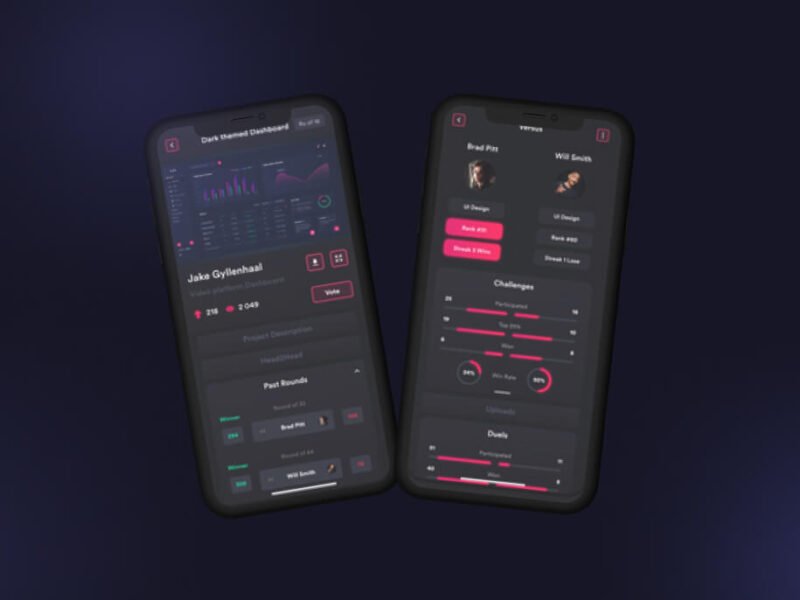


NFT Dashboard Application Development.
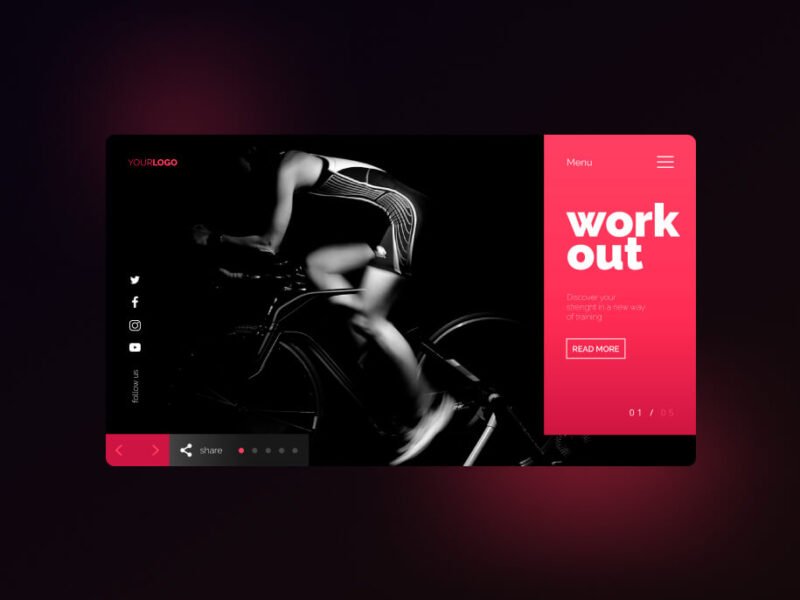
Through a wide variety of mobile applications, we’ve developed a unique visual system.
- Client George Wallace
- Date 15 June 2022
- Services Web Application
- Budget $100000+
I'm a copywriter and content writer who has worked in various web agencies and websites so
I understand what it takes to write an engaging webpage content that will make people linger.
I will make sure that I deliver in line with your needs and requirements. My goal is to exceed the expectations of every client!
I will rewrite pages, or provide original content for your website that includes:
Effective websites require quality content to best represent their brand or services.
If you want your website to achieve your sales goals, it must contain search engine optimized,
Through a wide variety of mobile applications, we’ve developed a unique visual system.
There are always some stocks, which illusively scale lofty heights in a given time period. However, the good show doesn’t last for these overblown toxic stocks as their current price is not justified by their fundamental strength.
A strategy is a general plan to achieve one or more long-term. labore et dolore magna aliqua.
UI/UX Design, Art Direction, A design is a plan or specification for art. which illusively scale lofty heights.
User experience (UX) design is the process design teams use to create products that provide.
Toxic companies are usually characterized by huge debt loads and are vulnerable to external shocks. Accurately identifying such bloated stocks and getting rid of them at the right time can protect your portfolio.
Overpricing of these toxic stocks can be attributed to either an irrational enthusiasm surrounding them or some serious fundamental drawbacks. If you own such bubble stocks for an inordinate period of time, you are bound to see a massive erosion of wealth.


However, if you can precisely spot such toxic stocks, you may gain by resorting to an investing strategy called short selling. This strategy allows one to sell a stock first and then buy it when the price falls.
While short selling excels in bear markets, it typically loses money in bull markets.
So, just like identifying stocks with growth potential, pinpointing toxic stocks and offloading them at the right time is crucial to guard one’s portfolio from big losses or make profits by short selling them. Heska Corporation HSKA, Tandem Diabetes Care, Inc. TNDM, Credit Suisse Group CS,Zalando SE ZLNDY and Las Vegas Sands LVS are a few such toxic stocks.Screening Criteria
Here is a winning strategy that will help you to identify overhyped toxic stocks:
Most recent Debt/Equity Ratio greater than the median industry average: High debt/equity ratio implies high leverage. High leverage indicates a huge level of repayment that the company has to make in connection with the debt amount.
Through a wide variety of mobile applications, we’ve developed a unique visual system.
There are always some stocks, which illusively scale lofty heights in a given time period. However, the good show doesn’t last for these overblown toxic stocks as their current price is not justified by their fundamental strength.
A strategy is a general plan to achieve one or more long-term. labore et dolore magna aliqua.
UI/UX Design, Art Direction, A design is a plan or specification for art. which illusively scale lofty heights.
User experience (UX) design is the process design teams use to create products that provide.
Toxic companies are usually characterized by huge debt loads and are vulnerable to external shocks. Accurately identifying such bloated stocks and getting rid of them at the right time can protect your portfolio.
Overpricing of these toxic stocks can be attributed to either an irrational enthusiasm surrounding them or some serious fundamental drawbacks. If you own such bubble stocks for an inordinate period of time, you are bound to see a massive erosion of wealth.


However, if you can precisely spot such toxic stocks, you may gain by resorting to an investing strategy called short selling. This strategy allows one to sell a stock first and then buy it when the price falls.
While short selling excels in bear markets, it typically loses money in bull markets.
So, just like identifying stocks with growth potential, pinpointing toxic stocks and offloading them at the right time is crucial to guard one’s portfolio from big losses or make profits by short selling them. Heska Corporation HSKA, Tandem Diabetes Care, Inc. TNDM, Credit Suisse Group CS,Zalando SE ZLNDY and Las Vegas Sands LVS are a few such toxic stocks.Screening Criteria
Here is a winning strategy that will help you to identify overhyped toxic stocks:
Most recent Debt/Equity Ratio greater than the median industry average: High debt/equity ratio implies high leverage. High leverage indicates a huge level of repayment that the company has to make in connection with the debt amount.
MBA in Marketing
GPA: 3.57 out of 4.0
BSc Engineering in Computer Science
and Engineering
GPA: 3.19 out of 4.0
- Developed multi-channel marketing strategies to boost client engagement and growth.
.
- Spearheaded client onboarding, conducted market research, and competitor analysis.
- Led the marketing and developer team, ensuring clear communication and cohesive project execution.
- Managed performance reporting, budgeting, and strategic monthly planning.
- Optimized digital ad campaigns across platforms, leveraging data insights to enhance targeting and maximize ROI for client accounts.
- Directed media buying campaigns, collaborating with CRM and creative teams.
- Monitored ad performance and optimize campaigns for maximum ROI.
- Created and refined sales funnels, improving conversion rates for high-ticket products.
- Implemented A/B testing strategies to fine-tune ad creatives and targeting, resulting in improved engagement and reduced acquisition costs.
- Designed and executed digital marketing strategies across all channels.
- Led the marketing team, fostering seamless client communication.
- Managed content marketing and influencer campaigns, driving brand visibility.
- Analyzed campaign performance metrics to identify growth opportunities, enhancing overall strategy and boosting audience engagement.
- Developed comprehensive digital strategies to enhance online presence.
- Established and managed e-commerce partnerships to boost sales.
- Directed content and influencer marketing, increasing brand awareness.
- Implemented targeted email marketing campaigns to nurture leads and drive conversions, contributing to increased customer retention and sales growth.


Maecenas finibus nec sem ut imperdiet. Ut tincidunt est ac dolor aliquam sodales. Phasellus sed mauris hendrerit, laoreet sem in, lobortis mauris hendrerit ante. Ut tincidunt est ac dolor aliquam sodales phasellus smauris

Maecenas finibus nec sem ut imperdiet. Ut tincidunt est ac dolor aliquam sodales. Phasellus sed mauris hendrerit, laoreet sem in, lobortis mauris hendrerit ante. Ut tincidunt est ac dolor aliquam sodales phasellus smauris

Maecenas finibus nec sem ut imperdiet. Ut tincidunt est ac dolor aliquam sodales. Phasellus sed mauris hendrerit, laoreet sem in, lobortis mauris hendrerit ante. Ut tincidunt est ac dolor aliquam sodales phasellus smauris
All the Lorem Ipsum generators on the Internet tend to repeat predefined chunks as necessary
1 Page with Elementor
Design Customization
Responsive Design
Content Upload
Design Customization
2 Plugins/Extensions
Multipage Elementor
Design Figma
MAintaine Design
Content Upload
Design With XD
8 Plugins/Extensions
All the Lorem Ipsum generators on the Internet tend to repeat predefined chunks as necessary
1 Page with Elementor
Design Customization
Responsive Design
Content Upload
Design Customization
2 Plugins/Extensions
Multipage Elementor
Design Figma
MAintaine Design
Content Upload
Design With XD
8 Plugins/Extensions
All the Lorem Ipsum generators on the Internet tend to repeat predefined chunks as necessary
1 Page with Elementor
Design Customization
Responsive Design
Content Upload
Design Customization
2 Plugins/Extensions
Multipage Elementor
Design Figma
MAintaine Design
Content Upload
Design With XD
8 Plugins/Extensions

Website optimization is the key to turning visitors into clients in today’s digital world. As competition grows fiercer, it’s no longer enough to simply have an online presence; your site must be designed to convert, engage, and enhance the user experience. In 2026, we’re dealing with smarter audiences, faster tech, and higher user expectations. Visitors now expect flawless performance, personalization, and smooth navigation — and if they don’t find it, they’re gone in seconds.
Think of optimization as an ongoing commitment rather than a one-time fix. The best optimization strategies are built on data, empathy, and psychology, which together make for a website that feels human, responsive, and valuable. So, how do we create a user experience that not only attracts but retains? Let’s dive into the top conversion tactics you need to know in 2026.
In 2026, user-centered design (UCD) is the cornerstone of effective website optimization. This approach focuses on crafting every aspect of your site to suit real users’ needs, guiding them naturally through each page and making their journey as seamless as possible. A well-structured website should feel intuitive, enabling users to navigate with ease. Key steps in user-centered design include:
A user-centered approach ensures visitors feel comfortable on your site, creating an enjoyable and engaging experience that encourages them to explore further.
In today’s fast-paced digital world, speed is essential. A website that loads quickly signals respect for users’ time, directly impacting their experience and willingness to stay. For 2026, ensuring that your site meets high-speed standards is a top priority. Here’s how to optimize speed effectively:
Speed is not just a technical factor; it directly affects user engagement and can significantly reduce bounce rates, keeping visitors on your site longer.
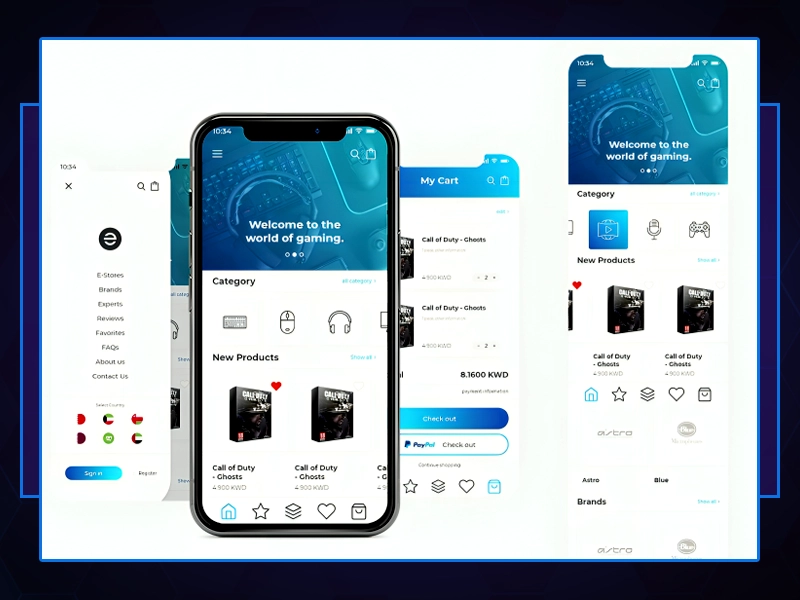
With mobile traffic continuing to rise, optimizing for mobile is essential in 2026. A mobile-first design approach means designing with mobile users in mind from the start, ensuring the experience is as smooth on small screens as it is on desktop. Key areas to focus on include:
A mobile-first approach ensures that visitors can interact with your site seamlessly, regardless of their device, and enjoy a high-quality experience.
Personalization is a powerful tool for engaging visitors and enhancing their experience by making them feel uniquely valued. Personalization in 2026 goes beyond simple recommendations; it’s about creating a customized journey that resonates with users. Here’s how to achieve effective personalization:
Personalization builds trust and loyalty, making visitors feel understood and encouraging them to return, which ultimately boosts conversions.
CRO is all about refining your site based on data-driven insights to maximize conversions. A/B testing, where you compare two versions of a page element, is fundamental in understanding what resonates best with your audience. Key aspects of CRO include:
CRO is a continuous process that hones in on user preferences, making your website increasingly effective in driving conversions.
To attract high-quality traffic, your website must be optimized for search engines. SEO focuses on increasing your site’s visibility to users who are actively searching for services like yours. In 2026, effective SEO practices include:
A solid SEO strategy attracts organic traffic from people interested in your offerings, increasing the likelihood of conversions.
Building trust is essential for encouraging conversions. Social proof—such as reviews, testimonials, and user-generated content—demonstrates that others have had a positive experience with your brand, while trust signals provide additional security. Key trust-building elements include:
These trust elements create a credible and reassuring environment, making visitors more likely to convert.
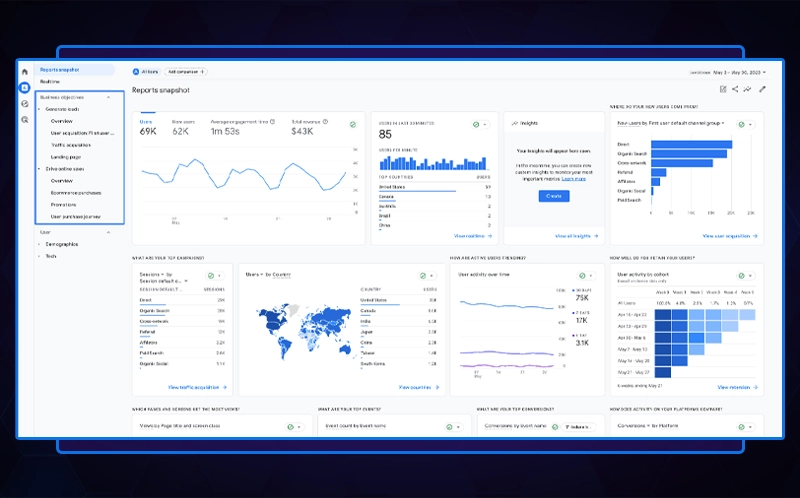
To optimize effectively, you need to understand how users interact with your site. Analytics tools provide the insights needed to make data-driven decisions, enabling you to adapt and refine continuously. Focus areas include:
Analytics allows you to base decisions on actual user behavior, refining your site for optimal engagement.
Read More: AI in Copywriting: How to Craft Compelling Messages Faster in 2026
Your site’s goal is to guide users smoothly through a funnel that leads to conversion. Each page should play a part in encouraging users toward an end goal, whether that’s a purchase, sign-up, or form submission. Key elements include:
An optimized funnel guides users smoothly from start to finish, increasing the chances they’ll complete the desired action.
Interactive elements engage users, making them more likely to stay on your site and convert. Interactive content provides value and enhances the overall experience. Popular interactive elements include:
Interactive elements create a memorable user experience that keeps visitors engaged and connected to your site.
In 2026, website optimization isn’t just a checklist; it’s a dynamic strategy that combines speed, functionality, personalization, and data-driven adjustments to meet user expectations. By focusing on these top tactics, you’re setting your website up to not only attract traffic but also convert it effectively.
Think of your website as a constantly evolving platform that adapts to the needs and behaviors of your audience. With user-centered design, mobile-first layouts, fast load speeds, and personalization, you’ll build a website that not only draws people in but makes them want to stay, engage, and convert.
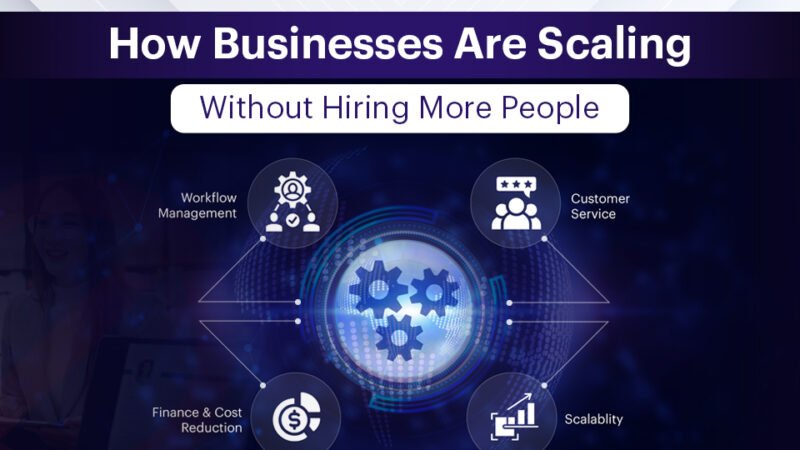
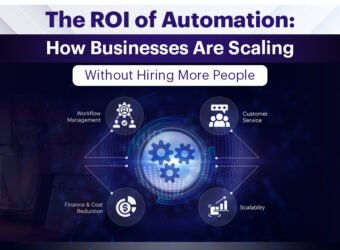
Across nearly every industry, one pattern has become increasingly clear: Businesses are scaling faster than ever—without increasing headcount.
Instead of relying on larger teams, companies are investing in smarter systems. Automation has evolved from a “nice-to-have” efficiency tool into a core growth strategy, enabling organizations to streamline workflows, reduce manual effort, and achieve more with the same number of people. But the most important question leaders ask is simple:
What is the real ROI of automation—and why are so many businesses choosing it over hiring?
This article breaks down the financial, operational, and strategic returns automation delivers—and why it has become one of the highest-ROI investments modern businesses can make.
Hiring employees comes with long-term financial commitments: salaries, onboarding, benefits, training, and ongoing overhead. Automation removes many of these recurring costs by handling work that previously required manual labor.
A key benefit is improved operational efficiency, which research shows is a primary driver of sustainable cost reduction.
Automation helps teams:
Instead of scaling payroll, businesses scale output.
Example:
A company that once required three employees to handle lead entry, follow-ups, and reporting can automate all three—reducing labor costs for that function by up to 60–70%. Small automations compound into major savings over time.
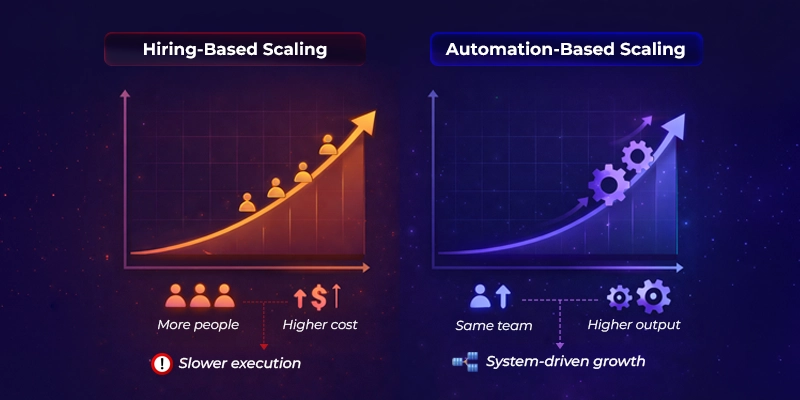
Traditionally, growth meant hiring more people. Today, businesses scale through systems. Automation accelerates scalability by enabling process automation, which reduces cycle times and increases throughput.
With automation, businesses can:
—all without increasing team size.
This is why automation is often described as a scaling multiplier rather than a cost-saving tool.
Modern customers expect fast, consistent, and personalized experiences. Automation delivers all three—without increasing workload. By leveraging tools like customer journey mapping, businesses can design automated paths that adapt to customer behavior and intent.
Automation enables:
These experiences once required large support teams. Today, automation executes them reliably at scale.
ROI impact includes:
Manual processes inevitably introduce errors: missed follow-ups, incorrect data entry, inconsistent messaging, and forgotten tasks. Automation eliminates these risks by executing workflows the same way every time. Studies on workflow standardization show that automation dramatically improves consistency by removing human variability.
Why this matters for ROI:
Automation delivers dependable outcomes without constant supervision.
Automation doesn’t replace employees—it empowers them. When teams aren’t stuck doing repetitive tasks, they can focus on strategic, creative, and revenue-driving work. Research on workforce productivity shows that automation allows employees to contribute more value without increasing stress.
Automation improves productivity by:
ROI insight:
One employee supported by automation can often perform the work of three—not through overwork, but through better systems.
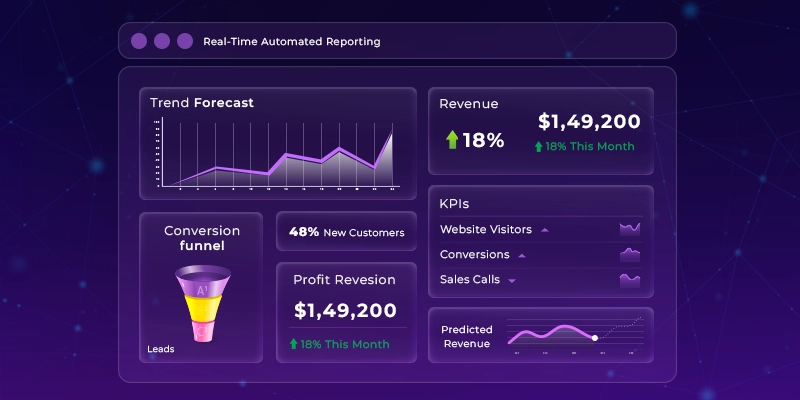
One of automation’s most underestimated benefits is data collection.
Automated systems track:
This data fuels predictive analytics, which improve forecasting accuracy and decision-making.
Benefits include:
Automation doesn’t just save money—it amplifies intelligence.
Unlike employees, automation doesn’t scale costs linearly.
Each automated workflow:
This compounding effect is why automation often delivers ROI far beyond traditional investments.
Returns appear in:
Businesses that scale through automation gain clear advantages:
In competitive markets, automation becomes one of the few sustainable ways to grow without burning resources or burning out teams.
Automation has evolved into a growth engine, not just a productivity tool.
It delivers measurable ROI through:
Most importantly, automation enables businesses to scale without hiring more people—creating leaner operations, stronger margins, and long-term competitive advantage. The businesses that invest in automation today will become the category leaders of tomorrow.

Marketing automation is one of the most powerful systems a modern business can implement. When done right, it saves time, nurtures leads automatically, personalizes communication at scale, and creates consistent customer experiences without constant manual effort. But here’s the reality:
Most businesses are using marketing automation incorrectly. Instead of driving growth, poorly designed automations quietly damage engagement, reduce trust, and leave revenue on the table. The problem isn’t automation itself—it’s how it’s implemented.
Understanding these mistakes, and knowing how to fix them, is essential for building automation systems that actually support growth instead of creating friction. Below are the most common marketing automation mistakes and how to correct them.
Many businesses jump into automation tools without a clear plan. They build workflows that overlap, contradict each other, or trigger at the wrong moments. This usually happens when teams skip the foundational step of designing automation workflows—clearly mapping triggers, actions, and conditions before implementation.
Without strategy, automation becomes chaotic instead of efficient.
How to fix it:
A clear strategy ensures automations work together—not against each other.
Not every interaction should be automated. One of the fastest ways to damage trust is removing human judgment from moments that require empathy or nuance. This often happens when teams misunderstand the purpose of marketing automation systems, which are meant to support communication—not replace relationships.
When everything feels automated, your brand starts to feel robotic.
How to fix it:
Efficiency without empathy creates distance.
One of the biggest automation killers is treating all contacts the same. Sending identical messages to everyone leads to:
Effective automation depends on marketing segmentation, which groups users based on behavior, interest, and lifecycle stage. Without segmentation, automation amplifies irrelevance.
How to fix it:
Relevant messaging always outperforms volume.
Marketing automation is not a “set and forget” system. Customer behavior changes, markets evolve, and workflows degrade over time. Many businesses neglect automation analytics, which reveal where users drop off, disengage, or stop converting.
Without measurement, automation can quietly fail for months.
How to fix it:
Automation should evolve alongside your audience.
Automation is only as effective as the data powering it. Duplicate contacts, incorrect fields, and incomplete records break:
This is why data quality management is critical for reliable automation.
Messy data leads to broken workflows.
How to fix it:
Clean data = accurate automation.
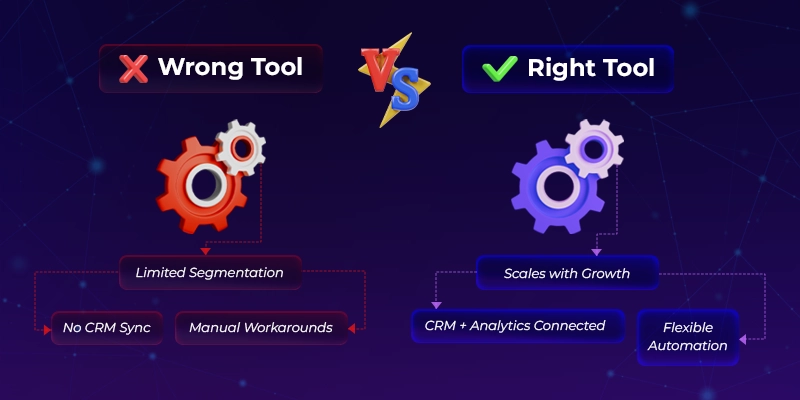
Many businesses choose automation tools based on price instead of fit. The result is limited segmentation, poor reporting, and weak integrations. Before committing, it’s important to evaluate marketing automation platforms based on scalability, features, and ecosystem compatibility.
The wrong tool adds friction instead of removing it.
How to fix it:
The right platform simplifies everything downstream.
Customers expect relevance. Generic automation feels lazy—and damages engagement.
True personalization goes beyond name tokens. It includes:
Automation should adapt to users, not force users into rigid sequences.
How to fix it:
When automation feels human, customers respond.
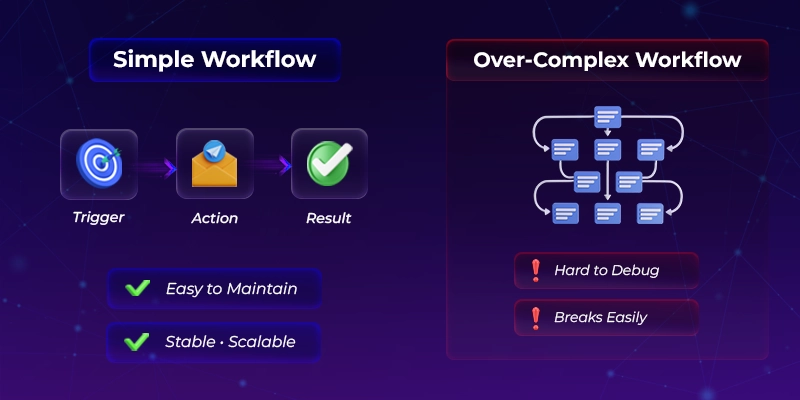
Beginners often create large, multi-branch automations that are hard to debug and maintain. When something breaks, no one knows why.
How to fix it:
Stable systems outperform complicated ones.
Automation should connect sales and marketing—not create silos. When teams disagree on lead scoring, handoff timing, or lifecycle stages, automation breaks silently.
How to fix it:
Alignment turns automation into a growth engine.
Automation accelerates repetitive tasks—but it cannot replace empathy, judgment, or trust. The most effective systems leave room for humans to intervene when it matters.
How to fix it:
Automation works best when it feels invisible.
Marketing automation is powerful—but only when implemented with intention. By avoiding these common mistakes and applying the fixes above, businesses can build automation systems that:
Automation should make your marketing smarter—not louder.

I am available for freelance work. Connect with me via and call in to my account.
Phone: +01234567890 Email: admin@example.com