

Marketing automation is one of the most powerful systems a modern business can implement. When done right, it saves time, nurtures leads automatically, personalizes communication at scale, and creates consistent customer experiences without constant manual effort. But here’s the reality:
Most businesses are using marketing automation incorrectly. Instead of driving growth, poorly designed automations quietly damage engagement, reduce trust, and leave revenue on the table. The problem isn’t automation itself—it’s how it’s implemented.
Understanding these mistakes, and knowing how to fix them, is essential for building automation systems that actually support growth instead of creating friction. Below are the most common marketing automation mistakes and how to correct them.
1. Automating Without a Clear Strategy
Many businesses jump into automation tools without a clear plan. They build workflows that overlap, contradict each other, or trigger at the wrong moments. This usually happens when teams skip the foundational step of designing automation workflows—clearly mapping triggers, actions, and conditions before implementation.
Without strategy, automation becomes chaotic instead of efficient.
How to fix it:
- Define one clear goal per automation
- Map the customer journey manually first
- Build and test one workflow at a time
A clear strategy ensures automations work together—not against each other.
2. Over-Automating Everything
Not every interaction should be automated. One of the fastest ways to damage trust is removing human judgment from moments that require empathy or nuance. This often happens when teams misunderstand the purpose of marketing automation systems, which are meant to support communication—not replace relationships.
When everything feels automated, your brand starts to feel robotic.
How to fix it:
- Keep human involvement where personalization matters
- Automate predictable, repetitive tasks only
- Use automation to assist—not replace—people
Efficiency without empathy creates distance.
3. Poor Segmentation
One of the biggest automation killers is treating all contacts the same. Sending identical messages to everyone leads to:
- Low engagement
- High unsubscribe rates
- Misaligned messaging
Effective automation depends on marketing segmentation, which groups users based on behavior, interest, and lifecycle stage. Without segmentation, automation amplifies irrelevance.
How to fix it:
- Segment by behavior and engagement
- Segment by lifecycle stage
- Use dynamic, real-time conditions
Relevant messaging always outperforms volume.
4. Ignoring Performance Analytics
Marketing automation is not a “set and forget” system. Customer behavior changes, markets evolve, and workflows degrade over time. Many businesses neglect automation analytics, which reveal where users drop off, disengage, or stop converting.
Without measurement, automation can quietly fail for months.
How to fix it:
- Review automation performance monthly
- A/B test subject lines and content
- Update outdated triggers and messages
Automation should evolve alongside your audience.
5. Using Dirty or Inaccurate Data
Automation is only as effective as the data powering it. Duplicate contacts, incorrect fields, and incomplete records break:
- Personalization
- Lead scoring
- Trigger accuracy
This is why data quality management is critical for reliable automation.
Messy data leads to broken workflows.
How to fix it:
- Standardize form fields
- Remove duplicates regularly
- Apply validation rules
Clean data = accurate automation.
6. Choosing the Wrong Automation Tool
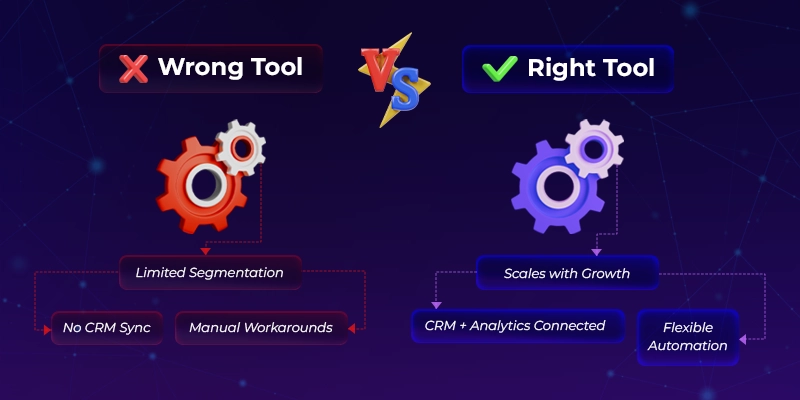
Many businesses choose automation tools based on price instead of fit. The result is limited segmentation, poor reporting, and weak integrations. Before committing, it’s important to evaluate marketing automation platforms based on scalability, features, and ecosystem compatibility.
The wrong tool adds friction instead of removing it.
How to fix it:
- Identify non-negotiable features first
- Ensure CRM and analytics integration
- Choose tools that grow with your business
The right platform simplifies everything downstream.
7. Not Personalizing the Customer Experience
Customers expect relevance. Generic automation feels lazy—and damages engagement.
True personalization goes beyond name tokens. It includes:
- Behavior-based timing
- Dynamic content blocks
- Context-aware messaging
Automation should adapt to users, not force users into rigid sequences.
How to fix it:
- Trigger messages based on actions, not schedules alone
- Customize content using interest and behavior data
- Continuously refine personalization logic
When automation feels human, customers respond.
8. Building Overly Complex Workflows Too Soon
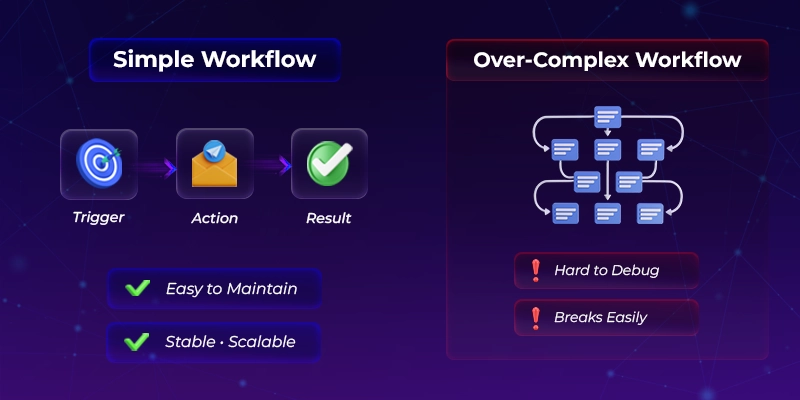
Beginners often create large, multi-branch automations that are hard to debug and maintain. When something breaks, no one knows why.
How to fix it:
- Start with simple workflows (welcome, re-engagement)
- Add complexity only when needed
- Document every automation clearly
Stable systems outperform complicated ones.
9. Poor Alignment Between Sales and Marketing
Automation should connect sales and marketing—not create silos. When teams disagree on lead scoring, handoff timing, or lifecycle stages, automation breaks silently.
How to fix it:
- Define shared lifecycle stages
- Sync CRM fields across teams
- Review handoff rules regularly
Alignment turns automation into a growth engine.
10. Forgetting the Human Touch
Automation accelerates repetitive tasks—but it cannot replace empathy, judgment, or trust. The most effective systems leave room for humans to intervene when it matters.
How to fix it:
- Add manual checkpoints for high-value moments
- Allow overrides for sales or support teams
- Use automation to enhance—not erase—human connection
Automation works best when it feels invisible.
Final Thoughts
Marketing automation is powerful—but only when implemented with intention. By avoiding these common mistakes and applying the fixes above, businesses can build automation systems that:
- Improve customer experience
- Increase conversions
- Save time without losing trust
Automation should make your marketing smarter—not louder.